By: Joy Stephenson-Laws, JD, Founder and President
Some therapists now include breathwork in their practice. If a provider suggests it to you, it is fair to ask what the research shows. The short answer: in trials, regular breathing practice helped with stress and mood on average, to a modest degree; its effect on blood pressure is uncertain; and no single technique has been shown to work best.
Why breath is different
Without oxygen, brain cells start dying within minutes, and severe, permanent brain injury can follow in less than ten minutes.[1,2]
Breathing also differs from your other automatic functions. Your heart beats and your stomach digests food whether you think about it or not. Breathing runs on its own too, but you can take control of it whenever you decide to. When you change your breathing, your heart rhythm changes with it: your heart speeds up a little each time you breathe in and slows a little each time you breathe out.[3] Slow breathing makes those swings larger.[7]
What breathing does in the body
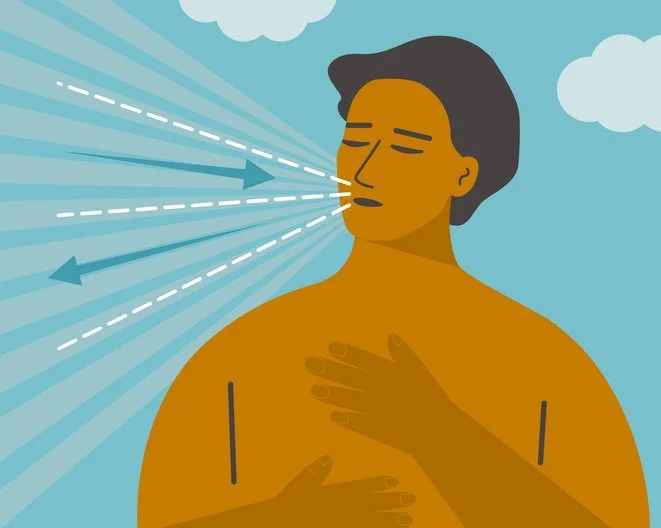
In a healthy person, breathing more does not bring in much more oxygen, because blood oxygen saturation is normally 95 to 100 percent.[4] Overbreathing, taking in more air than the body needs, can cause problems: it lowers the carbon dioxide in the blood, which narrows the blood vessels in the brain and makes fainting more likely.[5,6] The benefits of breathing practice come from the pace and rhythm of breathing, which act on the heart and the nerves that control it.
Stress, anxiety and mood
This is where the research is strongest. A review that pooled 12 randomized trials found that, on average, people who practiced breathing techniques reported less stress than people in comparison groups, with similar results for anxiety and depression. The effect was small to medium, and the authors warned against letting public excitement about breathwork run ahead of the evidence.[8]
In a Stanford trial, people who practiced five minutes a day for a month reported better mood and less anxiety after practice. A technique called cyclic sighing, two breaths in through the nose followed by a long breath out, raised positive mood more than meditation did.[3] In a larger and better-controlled UK trial, people breathed either slowly or at a normal pace for about ten minutes a day. Both groups improved, and the slower pace added no measurable benefit. The researchers suggested that breathing through the nose and into the belly, or the attention, expectation and time that any daily practice involves, may explain why both groups improved.[9]
Blood pressure
Here the evidence is uncertain. A 2019 review found that slow breathing lowered blood pressure by a few points in people with high or borderline-high readings, but the results varied widely, and in the best-designed studies the drop was not statistically significant.[10] For a commercial breathing device, the benefit was no longer statistically significant once trials tied to the manufacturer were removed, and the device showed no clear advantage over music or a fake device.[11,12]
Watching the breath
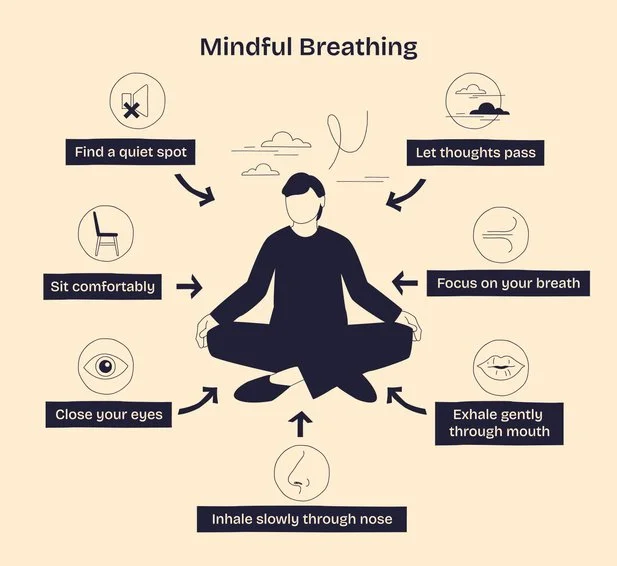
Breathwork usually means changing how you breathe. Mindfulness uses the breath without changing it: you pay attention to each breath, and when your mind wanders, you bring it back. A Johns Hopkins review of 47 trials found that mindfulness programs produced small to moderate improvements in anxiety, depression and pain, and found no evidence that they did better than medication, exercise or other therapies.[13] The review could not separate the effect of attention to the breath from the rest of those programs.
For some people, close attention to the body can raise anxiety, because a small change such as a faster heartbeat can feel like danger.[3]
Breath in spiritual practice
Breathwork often comes with spiritual language, and the connection is old. The English word spirit comes from the Latin spiritus, which means breath.[15] In Genesis, life begins when God "breathed into his nostrils the breath of life."[16] In Sanskrit, prana means breath, and yoga trains control of it through pranayama.[17] A classic yoga manual says, "Respiration being disturbed, the mind becomes disturbed."[18] Buddhist and Eastern Orthodox traditions both join attention to the breath with meditation and prayer.[19,20]
Researchers have measured what some of these practices do in the body. In a small Italian study, reciting the rosary in Latin or a yoga mantra slowed breathing to about six breaths a minute, close to the slow pace used in many breathing studies, and produced larger swings in heart rhythm.[14] The study did not measure how people felt, and it says nothing about whether either tradition's spiritual claims are true.
Safety
The trials that reported on side effects found few, but many did not track them.[8] In one depression trial, a few people in a yoga program that included fast breathing reported hot flushes, shortness of breath and sweating.[8] The Stanford trial excluded people with heart disease, seizures, glaucoma, pregnancy and several psychiatric conditions,[3] so it does not show how breathwork affects people with those conditions.
Questions to ask before you start
Which technique is it, and has that technique been tested?
What benefit should I expect, and how will we know whether it is working?
Is this in addition to my other treatment or in place of it? The research shows modest effects and does not show breathwork outperforming other treatments.[8,13]
Does it include fast breathing or breath holds? Have I been asked about heart problems, seizures, glaucoma or pregnancy?
How often, and for how long? The trials described here used five to ten minutes a day over several weeks.[3,9] A review of 58 studies found that the programs that worked more often used sessions of at least five minutes, guidance from a person, and practice over time.[21]
What this means
Breathing is an automatic function you can also take control of, and changing it changes the rhythm of your heart. In trials, regular breathing practice helped with stress and mood on average, to a modest degree. Its effect on blood pressure is uncertain, and no technique has been shown to work best, so if you try it, choose a technique that suits your health, and keep practicing only if it helps. If a provider offers breathwork, it is reasonable to try it as one part of your care and to ask the questions above.
Joy Stephenson-Laws, JD, is the founding and managing partner of Stephenson, Acquisto & Colman, a healthcare litigation firm, and the founder and president of Proactive Health Labs, a national nonprofit focused on evidence-based health literacy. A healthcare attorney for more than forty years and a certified holistic wellness coach, she writes about how people can partner with their doctors without surrendering their own judgment.
Her books include Your Labs Are Fine. You're Not., Advice on Trial: The Beliefs You Inherited but Never Examined, From Chains to Wings: A Poetry Revolution for Healing,Secrets That Sparkle (and Secrets That Sting), and Minerals - The Forgotten Nutrient: Your Secret Weapon for Getting and Staying Healthy.
(This article is for general education and is not medical advice. It is meant to help you ask better questions, not to replace evaluation by a qualified clinician).
RESOURCES & FURTHER READING
MedlinePlus. Cerebral hypoxia. National Library of Medicine; reviewed July 31, 2026. medlineplus.gov
Dreier JP, Major S, Foreman B, et al. Terminal spreading depolarization and electrical silence in death of human cerebral cortex. Ann Neurol. 2018;83(2):295-310. doi:10.1002/ana.25147
Balban MY, Neri E, Kogon MM, et al. Brief structured respiration practices enhance mood and reduce physiological arousal. Cell Rep Med. 2023;4(1):100895. doi:10.1016/j.xcrm.2022.100895
MedlinePlus. Pulse oximetry. National Library of Medicine; updated September 12, 2024. medlineplus.gov
Gouvea Bogossian E, Peluso L, Creteur J, Taccone FS. Hyperventilation in adult TBI patients: how to approach it? Front Neurol. 2021;11:580859. doi:10.3389/fneur.2020.580859
Norcliffe-Kaufmann L, Galindo-Mendez B, Garcia-Guarniz AL, Villarreal-Vitorica E, Novak V. Transcranial Doppler in autonomic testing: standards and clinical applications. Clin Auton Res. 2018;28(2):187-202. doi:10.1007/s10286-017-0454-2
Zaccaro A, Piarulli A, Laurino M, et al. How breath-control can change your life: a systematic review on psycho-physiological correlates of slow breathing. Front Hum Neurosci. 2018;12:353. doi:10.3389/fnhum.2018.00353
Fincham GW, Strauss C, Montero-Marin J, Cavanagh K. Effect of breathwork on stress and mental health: a meta-analysis of randomised-controlled trials. Sci Rep. 2023;13(1):432. doi:10.1038/s41598-022-27247-y
Fincham GW, Strauss C, Cavanagh K. Effect of coherent breathing on mental health and wellbeing: a randomised placebo-controlled trial. Sci Rep. 2023;13(1):22141. doi:10.1038/s41598-023-49279-8
Chaddha A, Modaff D, Hooper-Lane C, Feldstein DA. Device and non-device-guided slow breathing to reduce blood pressure: a systematic review and meta-analysis. Complement Ther Med. 2019;45:179-184. doi:10.1016/j.ctim.2019.03.005
Mahtani KR, Nunan D, Heneghan CJ. Device-guided breathing exercises in the control of human blood pressure: systematic review and meta-analysis. J Hypertens. 2012;30(5):852-860. doi:10.1097/HJH.0b013e3283520077
Landman GWD, van Hateren KJJ, van Dijk PR, et al. Efficacy of device-guided breathing for hypertension in blinded, randomized, active-controlled trials: a meta-analysis of individual patient data. JAMA Intern Med. 2014;174(11):1815-1821. doi:10.1001/jamainternmed.2014.4336
Goyal M, Singh S, Sibinga EMS, et al. Meditation programs for psychological stress and well-being: a systematic review and meta-analysis. JAMA Intern Med. 2014;174(3):357-368. doi:10.1001/jamainternmed.2013.13018
Bernardi L, Sleight P, Bandinelli G, et al. Effect of rosary prayer and yoga mantras on autonomic cardiovascular rhythms: comparative study. BMJ. 2001;323(7327):1446-1449. doi:10.1136/bmj.323.7327.1446
Online Etymology Dictionary. Spirit. etymonline.com
Genesis 2:7, King James Version. biblegateway.com
Encyclopaedia Britannica. Prana. britannica.com
Svatmarama. Hatha Yoga Pradipika, ch. 2, v. 2. Translated by Pancham Sinh, 1914. sacred-texts.com
Anapanasati Sutta (Majjhima Nikaya 118). Translated by Thanissaro Bhikkhu, 2006. accesstoinsight.org
John Climacus. The Ladder of Divine Ascent, Step 27. Translated by Archimandrite Lazarus Moore. Harper & Brothers, 1959. azbyka.ru
Bentley, et al. Breathing practices for stress and anxiety reduction: conceptual framework of implementation guidelines based on a systematic review of the published literature. Brain Sci. 2023;13(12):1612. doi:10.3390/brainsci13121612