Neither Numb Nor Flooded
By: Joy Stephenson-Laws, JD, Founder and President
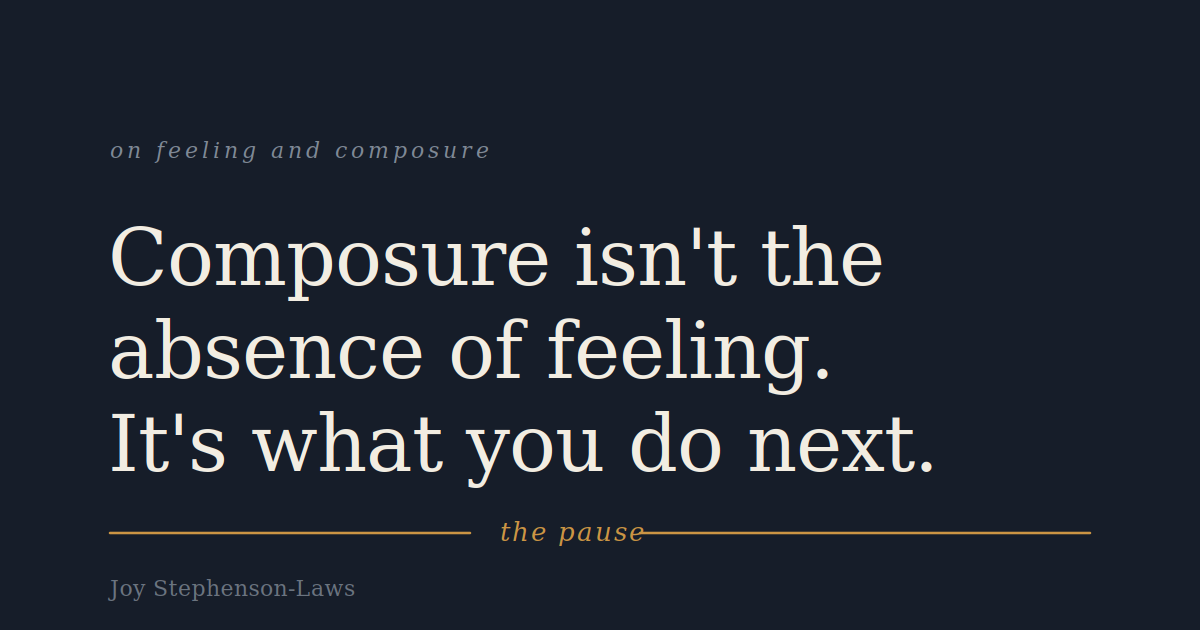
Composure isn't the absence of feeling. It's what you do in the pause.
"Don't cry."
"Keep it together."
"He held up so well at the funeral."
All three carry the same instruction: showing what you feel is weakness, and hiding it is strength.
I believed that for most of my working life. I am a lawyer. In a deposition you do not get to say a claim feels true. You find the document, you separate what you can prove from what you only suspect, and you show how the conclusion follows.
That is a rule about evidence. It says a feeling is not proof. It is right, and I would apply it again tomorrow.
There is a second rule I never examined. The first says a feeling is not proof. The second says a feeling should not show. I ran them together for years without noticing they were two different things.

My son was born and I could hardly feel the joy. I was running a firm. I left the hospital and went back to the office to make sure things were holding there and that the staff were all right. And later when my mother died, I stayed composed the whole way through, because the people around me were not going to hold if I did not. Keep it together. I was good at it by then.
This essay is about what the second rule costs. Some of what follows I assert from common experience, some follows from a definition, and some needs a study, in which case I name the study and say what it found.
What we know without a study
The child who stops crying gets called mature. The man who sits at his desk for ten hours the week after the diagnosis gets called focused. That is the way most of us grew up, and you can check it against your own memory faster than I could check it against a citation.
We also know what people reach for when composure does not arrive on its own, whether that is a drink at six o'clock or a pill or two more hours of work or a phone held a foot from the face until whatever was rising has nowhere to land. It is what an ordinary Tuesday looks like in many houses, and what it all has in common is that the feeling goes quiet.
So I assert that much as observation and not as science. We are trained to suppress, and we are taught to call it strength.
What suppression means here
The research calls the act expressive suppression. It means holding down the outward signs of an emotion after the emotion has started. Your face stays still and your voice stays level while the feeling runs.

That is narrower than numbness or dissociation or ignoring what your body is telling you. Those overlap in ordinary life and they are different processes, and I am keeping the strong claims tied to the narrow thing the studies measured.
The research usually compares suppression to cognitive reappraisal, which changes how you read a situation so the feeling itself shifts. You walk into the interview thinking of it as a chance rather than a test, and the fear moves. Reappraisal works on the meaning; suppression works on the face.
The costs that are established
Suppressing costs you the memory of whatever you were suppressing during.
Richards and Gross ran three studies on this in 2000. People watched a film, or slides of injured people, while a voice gave them information about what they were seeing. Some were told to hold their expressions still, some to reappraise, and some just watched. The ones holding their faces still remembered less of what they had been told, and the ones reappraising remembered as well as the ones doing nothing. Holding your face still takes continuous effort, and the effort runs on the same attention you would otherwise spend taking in the room.
Suppressing also loads the body. Tyra, Fergus and Ginty pooled twenty-four studies in 2024. When people were instructed to suppress during a laboratory stress task, their physiological reactivity ran higher than that of people given no such instruction, mostly in cardiac, hemodynamic and neuroendocrine measures. The effect was small, a Hedges' g of 0.20. Keeping the face still while the feeling runs adds a load to the body rather than settling it.

It also does not stay inside you. In 2003, Butler and colleagues put pairs of women who had never met into a conversation about an upsetting film. One woman in each pair was told to hide what she was feeling. The other woman's blood pressure went up. Nobody had told her anything. She simply found the conversation harder than it should have been.
What is not established
It would be easy to go from there to "suppression is ruining your health." The evidence does not carry that.
Everything above concerns the acute act, in a laboratory, on instruction. It says nothing about whether a person who has gone quiet for forty years ends up with heart disease. Tyra, Garner and Ginty looked at habitual suppression across three studies in 2025 and found no association with cardiovascular stress reactivity, and none with self-reported stress. They added that the literature here is thin enough that a file-drawer problem is possible, meaning null results may never have been published.
One qualification cuts against me and belongs here for that reason. The 2024 review found that people who report suppressing habitually did show greater neuroendocrine reactivity, even with unremarkable overall physiological reactivity. The signal is small, an r of 0.08. It is there.
So the short-term costs are measured, the long-term story is suspected and unproven, and the trait-level evidence is mixed and thin.
I make no claim that suppression shuts down your ability to feel what is happening in your body, or that it makes people miss symptoms they should have caught. Both sound right to me and I cannot support either one.
The cost you can work out yourself
This one needs no study, because it follows from what the word means.
Suppression is something you do to a feeling you already have. The emotion starts, and you hold down its expression. The feeling arrived first. You cannot suppress what you never felt.
Set that beside the memory finding. Holding the face still takes effort, and the effort competes with attention. While you are busy with the clamp, you have less left to ask what the feeling was about. The signal came in and you spent the moment silencing it. Do that often enough and the reading becomes the thing you never get to.
You can manage an emotion you never understood. What you cannot do is learn anything from it, because learning from it was the step you skipped.
Why "suppression is bad" is the wrong lesson
The simple version of that is false, and the research says so.
No strategy is good or bad by itself. Sometimes holding it down is exactly right. A surgeon forty minutes into an operation cannot afford to feel what she is going to feel that evening. She knows it, she puts it away deliberately, and she comes back for it later. The trouble starts when the tool becomes the only move a person owns.
Bonanno and Burton named this in 2013. They called the assumption that any single strategy is uniformly helpful or harmful the "fallacy of uniform efficacy," and proposed regulatory flexibility in its place: reading what a particular situation demands, having more than one response available, and changing course when the one you picked is not working. They described it as a construct still being defined rather than a settled finding.
Chen and colleagues put numbers to the culture question in 2025, across 249 articles, 150,474 people and 37 countries. Reappraisal was more clearly adaptive in cultures that are short-term-oriented, tolerant of uncertainty and driven by competition. Suppression was more clearly maladaptive in cultures that are indulgent and driven by competition. What they push hardest is that the old East-versus-West split is too coarse to explain the pattern. Where you are changes what the same act costs you.
Maturity means having more than one response available and knowing which one this room needs.
The pause
If the feeling has to arrive before it can be suppressed, then there is a moment between arrival and response, however brief. That moment is the pause.
Holding it open takes a deliberate act of attention, catching the reflex before it completes and staying with the feeling a moment longer than is comfortable. Discernment is what selects among the alternatives that space makes available.
That separates deliberate postponement from reflexive suppression, which people run together. Postponing needs enough of the feeling to register that setting it aside is a decision you made. Full understanding can wait. The registering cannot.
What matters is whether more than one response was available, and whether the one you took fit what the moment and your own values required. "Fit" here is not a verdict handed down from outside. It is whether the response served what you cared about at the time, the relationship, the goal, the person you are trying to be. You can hold yourself to that honestly, which is more than can be said for "was I appropriately composed."
This is why the surface tells you so little. Reflexive suppression and deliberate composure look identical from across the table, and so do honest tears and mere flooding. The difference is in whether the pause was there, and whether what came out of it was chosen.
Why show anything
If the pause lets you receive a feeling, understand it, and choose what it needs, why does any feeling need to come out? Why is the composed person, handling each one quietly, not doing it right every time?
The usual answer is that emotions build up like pressure and have to be released. On the version that has been tested, that answer fails. Bushman gave angry students a punching bag in 2002, with one group hitting it while thinking about the person who had angered them, one hitting it while thinking about getting fit, and a third sitting quietly and hitting nothing. The first group came away angrier and more aggressive than either of the others, and the group that sat still did best. He tested aggressive venting, so this does not settle what happens when you weep. It does dispose of the plumbing metaphor.
The reason to show a feeling comes from outside you.
At a funeral, visible grief tells the room what this person was, and lets the people who loved him see that someone else is carrying it. Anger shown on purpose tells someone a line was crossed that they would otherwise walk past again next week. The expression is doing a job silence cannot do.
So the pause asks what this room requires, on this afternoon.
That is what keeps any of this from turning into a new kind of toughness. It would be easy to read everything above as composure good, raw emotion immature. Sometimes the pause happens fully and its honest conclusion is to weep, now, in front of everyone. The person who has the pause can express more freely than the person who does not, because what comes out is aimed rather than spilled.
What this asks of you
We are trained to suppress and to call it strength, which is common experience. The act of suppressing has measured costs to memory, to the body's stress load, and to the person sitting across from you, which is established for the acute act whatever stays uncertain about a lifetime of it. And a feeling has to be received before it can be understood, which is what the words mean.
None of this makes composure the enemy. A calm face can sit on top of a woman reading her feeling and deciding to hold it, or a woman who honestly feels very little right now, or a woman clamping down at real cost. You cannot tell which from the outside, and she cannot always tell from the inside. That is less flattering than "the strong stay and the weak leave," and it is truer.

The skill worth wanting is the pause itself, and what you learn to do inside it. Notice what is happening. Understand it. Choose the response the moment calls for, whether that is composure, expression, action, or letting it pass.
If there is one thing to practice, it is building the pause earlier. The difference between reacting and choosing lives in the size of the gap between a feeling and what you do with it. The idea that our freedom lives in that gap is often traced to Viktor Frankl, though the wording usually quoted appears to be a later paraphrase rather than his own. When the gap is not there, feeling and response are the same event, and you are flung from one to the other whether you spill or clamp. As the pause widens, more of your life passes through discernment instead of around it. You feel no less. You just get to decide, a little more often, what the feeling is for.
Joy Stephenson-Laws, JD, is the founding and managing partner of Stephenson, Acquisto & Colman, a healthcare litigation firm, and the founder and president of Proactive Health Labs, a national nonprofit focused on evidence-based health literacy. A healthcare attorney for more than forty years and a certified holistic wellness coach, she writes about how people can partner with their doctors without surrendering their own judgment.
Her books include Your Labs Are Fine. You're Not., Advice on Trial: The Beliefs You Inherited but Never Examined, From Chains to Wings: A Poetry Revolution for Healing, Secrets That Sparkle (and Secrets That Sting), and Minerals: The Forgotten Nutrient.
Resources and references
Bonanno, G. A., & Burton, C. L. (2013). Regulatory flexibility: An individual differences perspective on coping and emotion regulation. Perspectives on Psychological Science, 8(6), 591–612. doi:10.1177/1745691613504116
Bushman, B. J. (2002). Does venting anger feed or extinguish the flame? Catharsis, rumination, distraction, anger, and aggressive responding. Personality and Social Psychology Bulletin, 28(6), 724–731. doi:10.1177/0146167202289002
Butler, E. A., Egloff, B., Wilhelm, F. H., Smith, N. C., Erickson, E. A., & Gross, J. J. (2003). The social consequences of expressive suppression. Emotion, 3(1), 48–67. doi:10.1037/1528-3542.3.1.48
Chen, M. S., Cai, Q., Omari, D., Sanghvi, D. E., Lyu, S., & Bonanno, G. A. (2025). Emotion regulation and mental health across cultures: A systematic review and meta-analysis. Nature Human Behaviour, 9(6), 1176–1200. doi:10.1038/s41562-025-02168-8
Gross, J. J. (2002). Emotion regulation: Affective, cognitive, and social consequences. Psychophysiology, 39(3), 281–291. doi:10.1017/S0048577201393198
Richards, J. M., & Gross, J. J. (2000). Emotion regulation and memory: The cognitive costs of keeping one's cool. Journal of Personality and Social Psychology, 79(3), 410–424. doi:10.1037/0022-3514.79.3.410
Tyra, A. T., Fergus, T. A., & Ginty, A. T. (2024). Emotion suppression and acute physiological responses to stress in healthy populations: A quantitative review of experimental and correlational investigations. Health Psychology Review, 18(2), 396–420. doi:10.1080/17437199.2023.2251559
Tyra, A. T., Garner, S.-B., & Ginty, A. T. (2025). Examining the association between habitual emotion regulation strategies and cardiovascular stress reactivity across three studies. Biological Psychology, 194, 108966. doi:10.1016/j.biopsycho.2024.108966