An alcohol-cancer link more people should know about
By: Joy Stephenson-Laws, JD, Founder and President
Updated September 2026
For anyone who has seen a headline about alcohol and cancer and did not know how much of it applied to them.
Feel
You saw a headline saying alcohol causes cancer, and something in you tightened. Maybe you thought about the glass of wine you had last night, or the two you have most nights. Maybe you thought about your father, or a friend.
Or maybe what you felt was irritation. You have read the opposite headline before, the one about red wine and the heart, and you are tired of being told that the drink you enjoy is killing you.
Both of those are information. Hold onto them for a minute before you decide what to do with this page.
Pause
Start with what is known.
Alcohol causes cancer. The link was first established in the late 1980s, and the International Agency for Research on Cancer classifies alcohol as a Group 1 carcinogen, alongside tobacco, asbestos, and formaldehyde. That is its highest category. In January 2025, the U.S. Surgeon General issued an advisory naming seven cancers with a causal link: breast in women, colorectum, esophagus, liver, mouth, throat, and voice box. The mechanism is understood. Your body converts ethanol into acetaldehyde, which binds to DNA and damages it. Alcohol also generates reactive oxygen species that damage DNA, proteins, and lipids, and it alters hormone levels including estrogen, which plays a role in breast cancer. Of the seven, breast cancer is the largest single burden in the U.S., with an estimated 44,180 cases in 2019.
What the headlines flatten is dose. The risk is not the same at every level and it is not the same for every cancer. For breast, mouth, and throat, the advisory says risk may begin to increase at around one drink a day or fewer. The other four take more than that. A standard U.S. drink is 14 grams of alcohol, which is 12 ounces of beer, 5 ounces of wine, or 1.5 ounces of spirits.
Absolute numbers tell you more than percentages. Among 100 women who have less than one drink a week, about 17 will develop an alcohol-related cancer over a lifetime. Among 100 women who have one drink a day, 19 will. At two drinks a day, about 22. For men the same three figures are 10, 11, and 13. One daily drink moves a woman's lifetime risk by about two and a half cases in a hundred. That is not nothing and it is not a death sentence, and you are the one who gets to decide what it is worth to you.
About 83 percent of the roughly 20,000 alcohol-related cancer deaths in the U.S. each year occur among people drinking above the old guideline limits of two drinks a day for men and one for women. The other 17 percent occur at levels within those limits.
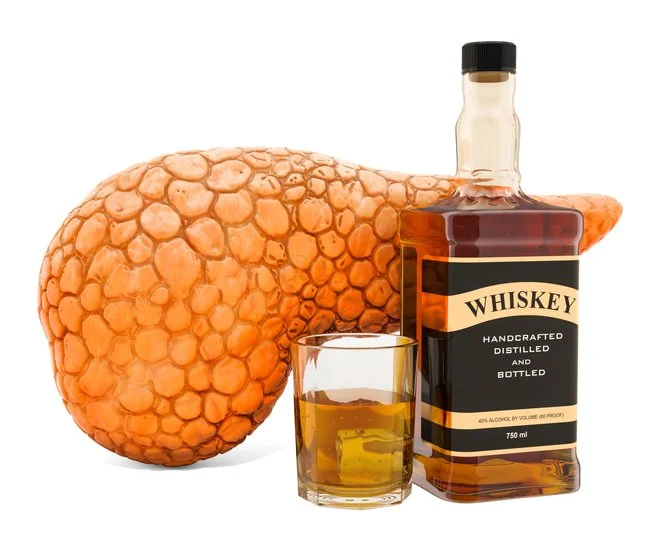
Pancreatic cancer is where this is being argued right now. It is not among the seven. The National Cancer Institute puts it a tier below, in a sentence noting that some evidence suggests an association. Two large studies have strengthened that case: an IARC-led pooling of 30 cohorts covering 2.5 million people, published in 2025, and a pooling of 37 cohort studies published in 2026. In the first, the association showed up from about 15 grams a day in women, which is just over one standard drink, and about 30 grams a day in men. The second put the threshold above 24 grams a day, a little under two drinks. Some coverage has reported that a single drink causes pancreatic cancer. Neither study found that.
The warning on U.S. alcohol containers has not changed since 1988 and says nothing about cancer, because changing it requires an act of Congress. In January 2026, the Dietary Guidelines for Americans removed the daily drink limits altogether. Neither of those is a finding about alcohol. They are decisions about labels and language.
Questions to ask yourself:
How many grams am I drinking in a week, rather than how many nights a week do I drink?
Which of the seven is closest to me, given my own history and my family's?
When I read a claim about alcohol, does it name a cancer and a dose, or only a cancer?
Act
Count for one week. Fourteen grams per standard drink, and pour a measured glass once so you know what your usual pour actually is. Most people are surprised.
Find your own line. A woman with a mother or sister who had breast cancer is looking at a different calculation than a man with none of the seven in his family. Write down which ones apply to you.
If you decide to cut back, cut the amount rather than the type. At the same dose no beverage is safer. Switching from spirits to wine does not do what changing the number does.
Use a three-part test on the next headline you see. Which cancer, what dose, and has any health body actually added it to its list. A story that names a cancer without naming a dose has not told you enough to act on.
Bring the number to your next appointment. Say the weekly total out loud rather than answering "socially."
Some people should not drink at all: anyone pregnant, anyone recovering from alcohol use disorder or unable to control the amount they drink, and anyone taking medications or living with conditions that interact with alcohol.
Talk with your doctor sooner if you have a family history of any of the seven cancers, if you take a medication you have never checked against alcohol, or if you have tried to cut back and found that you could not.
Joy Stephenson-Laws, JD, is the founding and managing partner of Stephenson, Acquisto & Colman, a healthcare litigation firm, and the founder and president of Proactive Health Labs, a national nonprofit focused on evidence-based health literacy. A healthcare attorney for more than forty years and a certified holistic wellness coach, she writes about how people can partner with their doctors without surrendering their own judgment.
Her books include Your Labs Are Fine. You're Not., Advice on Trial: The Beliefs You Inherited but Never Examined, From Chains to Wings: A Poetry Revolution for Healing, Secrets That Sparkle (and Secrets That Sting), and Minerals: The Forgotten Nutrient: Your Secret Weapon for Getting and Staying Healthy.
(This article is for general education and is not medical advice. It is meant to help you ask better questions, not to replace evaluation by a qualified clinician).
Resources and References
U.S. Surgeon General, Alcohol and Cancer Risk: The U.S. Surgeon General's Advisory, January 3, 2025. Full 22-page document read. https://www.hhs.gov/sites/default/files/oash-alcohol-cancer-risk.pdf
National Cancer Institute, Alcohol and Cancer Risk fact sheet, reviewed May 2, 2025. Full page read. https://www.cancer.gov/about-cancer/causes-prevention/risk/alcohol/alcohol-fact-sheet
U.S. Departments of Health and Human Services and Agriculture, Dietary Guidelines for Americans, 2025-2030, January 2026. Read in full (nine pages). https://cdn.realfood.gov/DGA.pdf
Naudin S, et al. Alcohol intake and pancreatic cancer risk: an analysis from 30 prospective studies across Asia, Australia, Europe, and North America. PLoS Medicine 2025;22(5):e1004590. Full text read. https://doi.org/10.1371/journal.pmed.1004590
Zhao J, Stockwell T, Naimi T, Clay J, Lawrence K, Sherk A. Alcohol consumption and the risk of pancreatic cancer: a systematic review and meta-analysis of cohort studies. International Journal of Alcohol and Drug Research 2026;14(2):75-91. Full text read. https://doi.org/10.7895/ijadr.649
(This post replaces a 2016 version built on a review by Jennie Connor in Addiction. The evidence base has moved since then and none of it is relied on here).