Your Appendix isn’t useless
What Doctors Got Wrong and Why It Matters
By Joy Stephenson-Laws, JD, Founder
I was 19 years old, a college student in California, when the pain hit. Within hours I was in surgery, and when I woke up, my appendix was gone. I don’t remember anyone hesitating about it. I don’t remember anyone explaining what I was losing. The message was simple: your appendix does nothing, it’s a leftover from evolution, and now that it’s inflamed, it needs to go.
That was it. Surgery. Recovery. Move on.
For nearly fifty years, I never gave my missing appendix a second thought. Every doctor I’d ever encountered treated it the same way — a useless organ, good riddance. Medical students learned that removing it was as consequential as trimming a hangnail.
It turns out they were wrong. And if you’re among the tens of millions of Americans walking around without an appendix — roughly 300,000 are removed each year, and appendectomy is most common in people aged 10 to 30, meaning many of us had no say in the decision — you deserve to know what the science now says about what was taken from you.
The “Useless Organ” Theory
The idea traces back to Charles Darwin. In The Descent of Man (1871), he proposed the appendix was a shrunken remnant of a larger cecum our ancestors used to digest plant matter. By the early 20th century, this was medical gospel. Surgeons didn’t just remove inflamed appendixes — some advocated removing healthy ones during unrelated abdominal surgeries. This thinking persisted unchallenged for over a hundred years.
What Your Appendix Was Actually Doing
Beginning in the early 2000s, researchers started looking more carefully — and what they found changed everything.
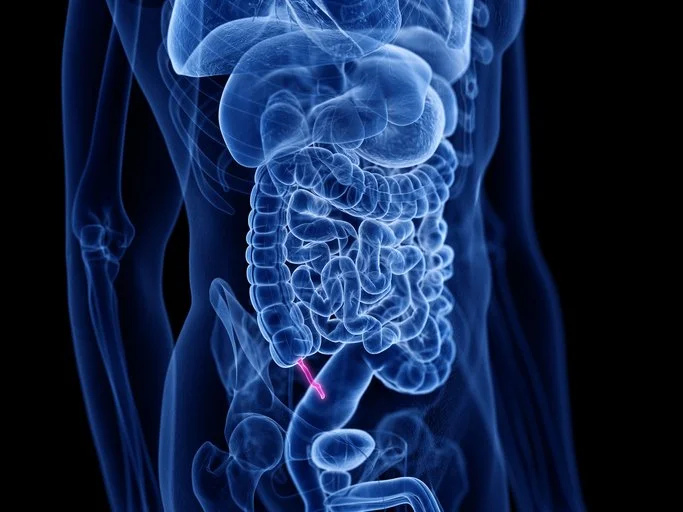
Your appendix is a safe house for beneficial gut bacteria. Your intestines are home to trillions of microorganisms — the gut microbiome — that play essential roles in digestion, immune function, inflammation control, and even mental health. The appendix, tucked in a small protected pouch at the beginning of the large intestine, maintains a reservoir of these beneficial bacteria coated in a protective biofilm. When your gut bacteria get wiped out — by food poisoning, a stomach illness, or antibiotics — the appendix reseeds the colon and restores balance.
Think of it like the cloud backup for your phone. If your phone gets wiped, the backup restores everything. Without it, you’re starting from scratch.
Your appendix is also an immune organ. It contains some of the densest concentrations of lymphoid tissue in the digestive tract — where specialized immune cells learn to distinguish friendly gut bacteria from dangerous invaders. It produces secretory IgA, the antibody that lines your intestinal walls as the first defense against infections entering through the gut. Removing the appendix doesn’t disable your immune system, but it removes one of its training camps.
What This Means If Yours Is Gone
Losing your appendix is not a health crisis. Millions of people live long, healthy lives without one. Your body compensates. But the compensation isn’t perfect, and the science now shows measurable differences.
Reduced microbiome diversity. A 2022 study published in Oncogene used advanced metagenomic sequencing to compare the gut bacteria of 314 people with and without their appendix. The appendectomy group showed measurably lower bacterial diversity, with depletion of five beneficial bacterial species and enrichment of seven species associated with disease. A separate 2024 study tested the safe house theory directly: after bowel preparation for colonoscopy disrupted participants’ gut bacteria, those without an appendix showed greater microbiome disruption and slower recovery than those with one intact. The safe house isn’t just a metaphor — it’s measurable.
Greater vulnerability to certain infections. People without an appendix have higher rates of Clostridium difficile infection — a serious gut infection that often follows antibiotic use. Without the appendix reseeding beneficial bacteria, harmful organisms face less competition when colonizing the gut.
Possible cardiovascular effects. A Swedish study published in the European Heart Journal followed over 54,000 people who had appendectomies before age 20 and found a moderately increased risk of heart attack over 23 years of follow-up. The proposed mechanism: removing lymphoid tissue may subtly alter the inflammatory processes involved in atherosclerosis. The absolute risk increase was small, and this is observational evidence that cannot prove causation. But it adds to the picture of an organ that wasn’t as disposable as we thought.
And If You Still Have Yours, This Could Save It
If you’re reading this while facing an appendicitis diagnosis — or if someone you love is — here’s what I wish I’d known at 19: surgery may not be your only option.
For over a century, appendicitis meant appendectomy, period. That assumption — that an inflamed appendix will inevitably rupture — isn’t always true. In the past decade, large clinical trials have challenged the surgery-first approach for uncomplicated appendicitis — inflammation without rupture, abscess, or peritonitis.
A landmark Finnish trial (APPAC) followed patients with uncomplicated appendicitis treated with antibiotics instead of surgery. At five years, 61% still had their appendix and had never needed an operation. A larger American trial (CODA), with over 1,500 patients, found comparable outcomes between antibiotics and surgery, with fewer disability days in the antibiotic group.
This doesn’t mean surgery is wrong — if the appendix has ruptured or there’s an abscess, surgery remains necessary and potentially life-saving. But what was once a reflexive trip to the operating room is now, in many hospitals, an informed discussion. If you or someone you know is facing appendicitis, ask: Is this uncomplicated? Are antibiotics an option? Not every surgeon will raise it. But the evidence is strong enough that you deserve the conversation.
What You Can Do Now
Whether yours is already gone or you’re hoping to keep it, the goal is the same: support the ecosystem the appendix was designed to protect.
Eat a wide variety of fiber-rich foods. Different fibers feed different bacterial species. Don’t just eat salads — eat different salads. Rotate your vegetables. Vary your grains. Every new plant food nourishes a different bacterial population. This is the single most effective way to build and maintain microbiome diversity.
Think of gut recovery as your vulnerable window. The appendix’s most important job was reseeding your gut after disruption. Without it, you need a deliberate recovery strategy. After any gut insult — antibiotics, food poisoning, a stomach virus, even the bowel preparation for a colonoscopy — your microbiome is temporarily destabilized and harmful bacteria can gain a foothold. This is when fermented foods matter most. Not as a general wellness habit, but as a targeted intervention during and immediately after disruption. Kimchi, sauerkraut, kefir, and miso introduce live bacteria that partially replicate the reseeding function your appendix would have performed. The first two weeks after a gut disruption are your highest-risk window. Treat them accordingly.
Be strategic with antibiotics. If you need antibiotics, take them — they save lives. But without an appendix, your gut recovery will be slower. Discuss probiotics with your doctor during or after any course.
Watch for prolonged gut symptoms after illness. If bloating, irregular bowel movements, or new food sensitivities linger after a stomach bug or antibiotics, your microbiome may be struggling to rebalance. Fiber diversity and fermented foods become especially important during these recovery periods.
The Bigger Lesson
My appendix was removed nearly fifty years ago, and I’m only now understanding what that meant. I don’t say this to create alarm — I say it because this story illustrates something I believe deeply: the human body does not carry spare parts. When medicine dismisses an organ as “useless,” that often reflects the limits of our understanding, not the limits of the organ’s function.
The appendix spent over a century being ridiculed as evolution’s leftover. It took until the 21st century for science to catch up with what the body already knew — that every structure is there for a reason, even if we haven’t figured out the reason yet.
If yours is gone, take care of the ecosystem it was designed to protect. If yours is still there and someone tells you it’s expendable, ask questions. Your gut bacteria are counting on that safe house. The least we can do is give them every chance to thrive.
Resources
Bollinger RR, Barbas AS, Bush EL, Lin SS, Parker W. Biofilms in the large bowel suggest an apparent function of the human vermiform appendix. Journal of Theoretical Biology, 2007;249(4):826–831.
Liang Y, Li Y, Lee C, et al. Altered gut microbiome composition by appendectomy contributes to colorectal cancer. Oncogene, 2023;42:530–540.
McGuinness AJ, O’Hely M, Stupart D, Watters D, Dawson SL, Hair C, et al. Prior appendicectomy and gut microbiota re-establishment in adults after bowel preparation and colonoscopy. Biomedicines, 2024;12(9):1938.
Janszky I, Mukamal KJ, Dalman C, Hammar N, Ahnve S. Childhood appendectomy, tonsillectomy, and risk for premature acute myocardial infarction—a nationwide population-based cohort study. European Heart Journal, 2011;32(18):2290–2296.
Salminen P, Tuominen R, Paajanen H, et al. Five-year follow-up of antibiotic therapy for uncomplicated acute appendicitis in the APPAC randomized clinical trial. JAMA, 2018;320(12):1259–1265.
CODA Collaborative; Flum DR, Davidson GH, Monsell SE, et al. A randomized trial comparing antibiotics with appendectomy for appendicitis. New England Journal of Medicine, 2020;383(20):1907–1919.
Babakhanov AT, Dzhumabekov AT, Zhao AV, et al. Impact of appendectomy on gut microbiota. Surgical Infections, 2021;22(7):651–661.
(Joy Stephenson-Laws is a healthcare attorney, certified holistic wellness coach, and founder of Proactive Health Labs. She is the author of "From Chains to Wings: A Poetry Revolution for Healing" and the children's book "Secrets That Sparkle (and Secrets That Sting)," which teaches children about emotional safety and the importance of trusted adults).