By: Joy Stephenson-Laws, JD, Founder and President
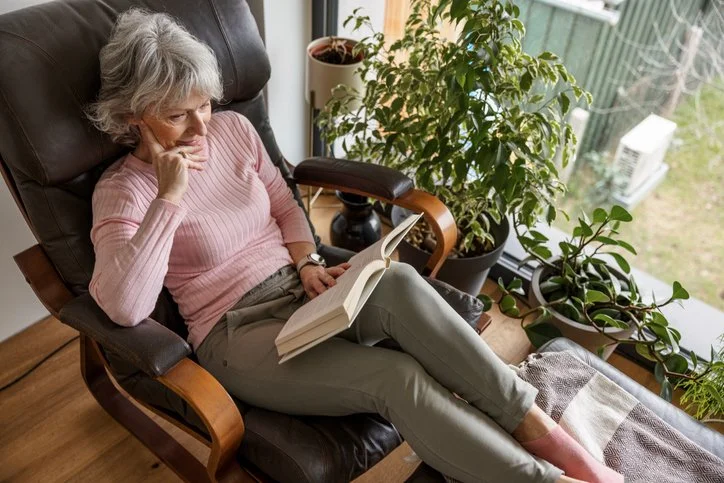
A woman over 60 spends a Saturday alone. She reads, makes lunch for one, takes a walk. She sleeps well. This is solitude that is working.
But when someone asks what she did over the weekend, she hesitates before answering. Because "nothing" sounds like a confession when you're over 60.
A younger woman spends the same Saturday and calls it self-care. Same outward behavior. Different permission to claim it. Both chose solitude. Only one of them feels allowed to.
The hesitation is worth paying attention to, but it is not loneliness. Loneliness is something else — a different psychobiological pattern with different downstream risks. The variable that separates the two is not simply whether you are alone. It is how your body and mind are registering that aloneness.
Your Body Is Always Reporting Something
Whatever you are doing on a given Saturday, your body is taking measurements. Cortisol, heart rate, sleep quality, inflammatory signaling. These are not metaphors. They are physical quantities your body is producing in real time.
When loneliness sets in, the readings can shift in characteristic ways. Hawkley and Cacioppo (2010) reviewed the model of loneliness as a state of heightened vigilance for social threat. This is not a personality flaw. It is a survival mechanism left over from a time when separation from the group meant being eaten. The problem is that in a modern 65-year-old, the alarm does not shut off, and when threat-surveillance stays chronically active, the body pays for it.
The downstream evidence is real but uneven. Adam, Hawkley, Kudielka, and Cacioppo (2006), studying 156 older adults, found that feelings of loneliness on a given evening predicted a higher cortisol awakening response the next morning. Loneliness on Friday night was setting the body's alarm for Saturday morning. Smith and colleagues (2020), in a systematic review and meta-analysis of 14 loneliness papers and 16 social-isolation papers, found loneliness associated with elevated interleukin-6 in most-adjusted analyses, though associations with CRP and fibrinogen were not significant. The cardiovascular and mortality data are heavier. Valtorta and colleagues (2016) pooled 23 studies of more than 181,000 adults and found poor social relationships associated with a 29 percent increase in coronary heart disease risk and a 32 percent increase in stroke risk. Holt-Lunstad and colleagues (2015), reviewing 70 prospective studies, found that loneliness, isolation, and living alone each independently predicted earlier death.
Three different forms of disconnection. Each one independently associated with earlier death. If loneliness were a pharmaceutical side effect, it would warrant a black box warning.
But here is the part that gets missed: the body's readings are neutral information. They are data, not meaning. The pause helps you ask what those signals belong to — restorative solitude, unwanted isolation, grief, illness, acute stress, or something else.
The Space Between What You Feel and What You Tell Yourself
In my own work, I call this space Feel-Pause-Act. The feel is the body's report. The pause is the moment before automatic story takes over. The act is what comes from clarity rather than reflex. I have written about this framework elsewhere. Here I want to show why the research supports it with more precision than most people realize.
Start with what chosen solitude actually does. Nguyen, Ryan, and Deci (2018) found that people who autonomously decided how to spend their solitary time experienced reduced high-arousal affect and reported relaxation. Tse, Lay, and Nakamura (2022) showed across three experience-sampling studies that unchosen solitary activities produced the lowest quality momentary experiences, while chosen solitary activities felt relatively benign. Nguyen, Konu, and Forbes (2025), using ecological momentary assessment, found that people were more likely to prefer solitude while experiencing high-arousal negative emotions, though those emotions did not predict actually being alone an hour later. Read alongside the experimental work, the finding supports a modest but useful claim: solitude can function as a context for emotional downregulation, especially when it is chosen rather than imposed.
The outward condition was the same in many of these studies: one person, one room, no social contact. What changed was how that condition was received — as chosen safety, or as imposed exposure.
This is consistent with how Hawkley and Cacioppo described loneliness. The threat-surveillance switch flips based on perceived isolation, not objective isolation alone. The body responds both to the objective situation and to whether the brain appraises it as chosen, safe, controllable, and reversible. Two women in identical rooms. One reads the silence as safety; the other reads it as exile. The biology follows the reading.
The pause is what stands between the body's report and the reflexive story. It is where you stop assuming the meaning of what you feel and instead ask what you are actually experiencing.
Two Honest Answers
When you pause and ask honestly, the body often points you toward one of two broad patterns. Both ask for different things from you.
The first pattern: this is chosen, and I am safe in my own company.
If this is the report, the research is on your side. Laura Carstensen at Stanford developed socioemotional selectivity theory (Carstensen, 1995) to explain a pattern that had been misread for decades. As people age, their social networks get smaller. The conventional interpretation was loss. Carstensen showed something different: older adults do not lose social partners randomly. They prune peripheral relationships and invest more deeply in a smaller number of emotionally meaningful ones. English and Carstensen (2014) found this selective narrowing was associated with improved daily emotional experience: more positive emotion, less negative emotion in social interactions.
A smaller social circle after 60 is not necessarily a warning sign. It may be an age-related emotion-regulation strategy that the culture has mistaken for decline. The act that follows this answer is quiet. Honor what is working. Stop apologizing for it. Stop letting other people's worry overwrite your nervous system's report.
The second pattern: this is not solitude. I am genuinely cut off, and no one would notice if I disappeared.
If this is the report, the inquiry has done its work. The biology of loneliness is real, and the data above shows what it costs. The act that follows this answer is active. Reach out. Rebuild. Seek help. Move.
The framework does not collapse when the answer is hard. It succeeds when the answer is honest.
The Cognition Question, Honestly
This piece would not pass a hostile-reader test without addressing what the research says about social networks and cognition. The emotional benefits of selective pruning are reasonably well-documented. The cognitive picture is more complicated.
Liao, Shavit, and Carstensen (2019), in a small lab study of 61 older adults, found that participants with fewer outer-circle social partners performed worse on the Backward Span working memory task five years later. Piolatto and colleagues (2022), in a meta-analysis of 34 longitudinal cohort studies, found poor social relationships associated with cognitive decline, while cautioning that publication bias may overestimate effects. Zhang, Zhang, and Gao (2025), in a 24-country study of over 101,000 adults, found social isolation associated with reduced memory, orientation, and executive function. The cognitive risk is real and increasingly documented.
But most of these studies do not distinguish chosen solitude from unchosen isolation in their cognitive outcomes. A woman who has deliberately curated a smaller, higher-quality social life is being grouped in the same data as a woman who has lost contact with people she used to see.
Feng (2025), in a conference abstract using Health and Retirement Study data on over 10,000 adults, found that larger networks protected against cognitive decline, while social stress from within the network increased the risk of rapid decline. Network quality mattered alongside network size. The pause is what tells you which side of the line you are on.
Reading the Report
Solitude becomes a health concern when it stops being chosen, restorative, or reversible. The transition can be gradual. These are the markers worth tracking:
The reason changed. You used to stay home because you wanted to. Now you stay home because going out feels like too much. That shift from preference to avoidance is worth paying attention to.
The body changed. Chosen solitude tends to feel calming. If your sleep has deteriorated, your resting heart rate has shifted, or your inflammatory markers (hs-CRP, IL-6) have started moving in the wrong direction, that is a signal worth investigating. These markers are nonspecific — they can shift for infection, medications, hormonal changes, or sleep disorders. Treat them as a prompt, not as proof.
The story changed. You used to describe your weekends as restful. Now you describe them as empty. Language tracks internal state more reliably than most people realize.
If any of these markers have shifted, trust what your body is reporting. Then consider whether a conversation with your healthcare provider could add precision.
When the Body Catches Up
A reasonable next question: when you tell yourself the true story, will your biology follow?
It will, but not instantly. Acute markers — heart rate, breathing, autonomic state — shift within minutes when the threat-surveillance system stands down. Sleep and mood take days to weeks as the new reading becomes habitual. Inflammation and cortisol patterns take weeks to months, and only if the new reading is lived consistently, not just thought once.
If the misreading has been years long, the body has been running threat biology underneath that whole time. The patterns flattened gradually. They do not instantly reset.
The body is also reporting on everything else: illness, loss, hormonal shifts, ordinary stress. The pause helps you read each input. It does not subtract the inputs.
And if the true story is that you are genuinely lonely, the acknowledgment is necessary but not sufficient. The biology will not shift until you act on it. The story has to become a life, not just a thought.
The body will eventually agree with a sustained true story. But the body is slow, and the story has to be lived to count.
What This Means
If your time alone feels restorative, your sleep is intact, your inflammatory markers are stable, and you are not avoiding connection out of fear, your solitude is not a problem to be solved. It may be one of the more sophisticated things your nervous system is doing for you.
Solitude is what you choose. Loneliness is what your body reports when the choice was not yours, or when the choice did not land as safety. Something you carried into the moment — conditioning, grief, an unfinished worry — kept your nervous system from registering that you were safe.
The woman who spent Saturday alone, read, made lunch for one, slept well, and then hesitated when someone asked what she did — her body had already given its answer. She slept, she moved, she ate, she returned to herself without distress. What she lacked was permission to receive the report.
Your body is always offering evidence. The pause is what makes you able to read it. The body that has carried you to 60 has earned the right to be believed.
Joy Stephenson-Laws, JD, is the founding and managing partner of Stephenson, Acquisto & Colman, a healthcare litigation firm, and the founder and president of Proactive Health Labs, a national nonprofit focused on evidence-based health literacy. A healthcare attorney for more than forty years and a certified holistic wellness coach, she writes about how people can partner with their doctors without surrendering their own judgment.
Her books include Your Labs Are Fine. You're Not., Advice on Trial: The Beliefs You Inherited but Never Examined, From Chains to Wings: A Poetry Revolution for Healing, Secrets That Sparkle (and Secrets That Sting), and Minerals: The Forgotten Nutrient.
RESOURCES AND REFERENCES
Adam, E. K., Hawkley, L. C., Kudielka, B. M. & Cacioppo, J. T. (2006). Day-to-day dynamics of experience-cortisol associations in a population-based sample of older adults. Proceedings of the National Academy of Sciences, 103(45), 17058-17063.
Carstensen, L. L. (1995). Evidence for a life-span theory of socioemotional selectivity. Current Directions in Psychological Science, 4(5), 151-156.
English, T. & Carstensen, L. L. (2014). Selective narrowing of social networks across adulthood is associated with improved emotional experience in daily life. International Journal of Behavioral Development, 38(2), 195-202.
Feng, J. (2025). The impact of active ingredients of social networks on the trajectory of cognitive decline in older adults [Abstract]. Innovation in Aging, 9(Suppl 2), igaf122.3000.
Hawkley, L. C. & Cacioppo, J. T. (2010). Loneliness matters: A theoretical and empirical review of consequences and mechanisms. Annals of Behavioral Medicine, 40(2), 218-227.
Holt-Lunstad, J., Smith, T. B., Baker, M., Harris, T. & Stephenson, D. (2015). Loneliness and social isolation as risk factors for mortality: A meta-analytic review. Perspectives on Psychological Science, 10(2), 227-237.
Liao, H. W., Shavit, Y. Z. & Carstensen, L. L. (2019). Selective narrowing of peripheral social networks predicts poor long-term cognition in old age [Abstract]. Innovation in Aging, 3(Suppl 1), S174-S175, igz038.621.
Nguyen, T. T., Konu, D. & Forbes, S. (2025). Investigating solitude as a tool for downregulation of daily arousal using ecological momentary assessments. Journal of Personality, 93(1), 31-50.
Nguyen, T. T., Ryan, R. M. & Deci, E. L. (2018). Solitude as an approach to affective self-regulation. Personality and Social Psychology Bulletin, 44(1), 92-106.
Piolatto, M., Bianchi, F., Rota, M., Marengoni, A., Akbaritabar, A. & Squazzoni, F. (2022). The effect of social relationships on cognitive decline in older adults: An updated systematic review and meta-analysis of longitudinal cohort studies. BMC Public Health, 22, 278.
Smith, K. J., Gavey, S., Riddell, N. E., Kontari, P. & Victor, C. (2020). The association between loneliness, social isolation and inflammation: A systematic review and meta-analysis. Neuroscience & Biobehavioral Reviews, 112, 519-541.
Tse, D. C. K., Lay, J. C. & Nakamura, J. (2022). Autonomy matters: Experiential and individual differences in chosen and unchosen solitary activities. Social Psychological and Personality Science, 13(5), 946-956.
Valtorta, N. K., Kanaan, M., Gilbody, S., Ronzi, S. & Hanratty, B. (2016). Loneliness and social isolation as risk factors for coronary heart disease and stroke: Systematic review and meta-analysis of longitudinal observational studies. Heart, 102(13), 1009-1016.
Zhang, W., Zhang, J. & Gao, N. (2025). Social isolation and cognitive decline in older adults: A longitudinal study across 24 countries. BMC Geriatrics, 25, 775.