How to Prevent Prostate Cancer: What Works, What Doesn't, and What Matters More
By: Joy Stephenson-Laws, JD, Founder and President
Most men want a short answer to this question. The short answers are mostly wrong, and the accurate one takes a few minutes to read.
Let's start with the gland itself.
What the prostate is and what it does
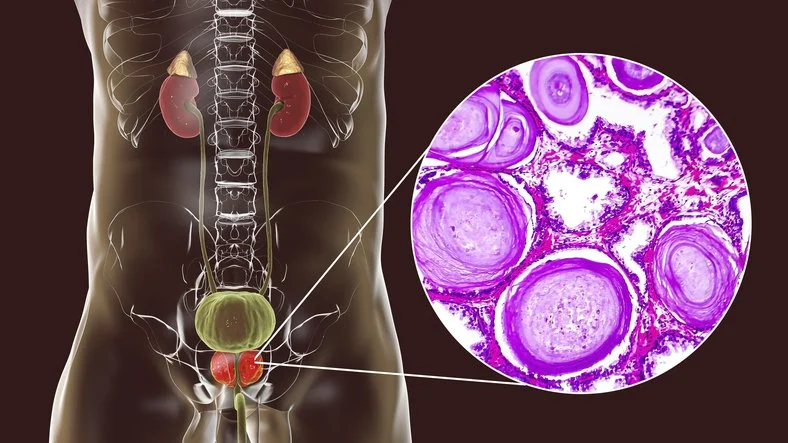
The prostate is a gland below the bladder, about the size of a walnut in a young man, and it grows with age. The urethra, the tube that carries urine out of the body, runs through the middle of it, which is why prostate problems often show up as trouble urinating. The prostate's main job is making fluid that mixes with sperm to form semen.
How testosterone acts on the prostate
Testosterone travels in the blood. In the prostate, an enzyme called 5-alpha reductase converts it into a stronger hormone, DHT, which tells prostate cells to grow. (An enzyme is a protein that speeds up a chemical reaction.) The two most studied prevention drugs, finasteride and dutasteride, both block that conversion.
Prostate cancers vary widely in how they behave
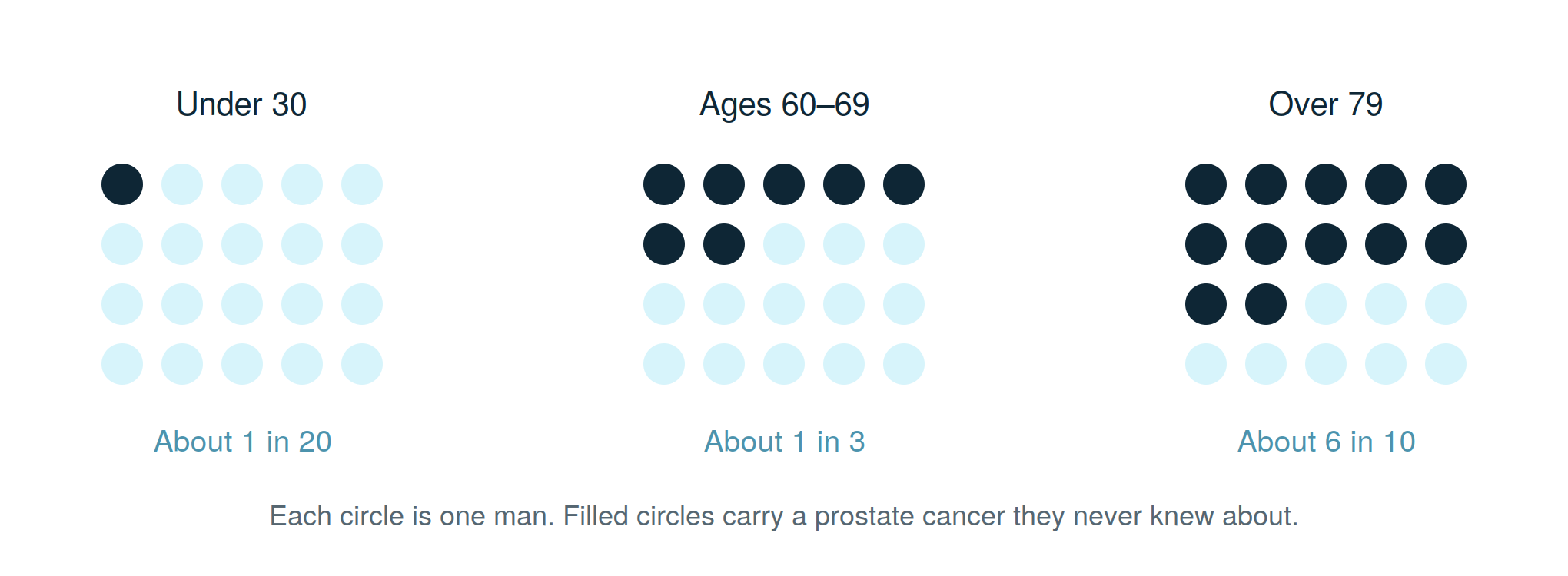
Many prostate cancers are small, slow and low-risk, and they are extremely common.
Researchers know this from autopsies of men who died of other causes. A review of 29 such studies estimated that about 5 percent of men under 30 already have a small prostate cancer, about 1 in 3 men in their 60s, and close to 6 in 10 men over 79. None of these men had been diagnosed. Many of these cancers never cause a symptom or shorten a life, and plenty of men die of something else in old age with one still in the gland.
High-risk cancers are more likely to grow beyond the prostate, spread (often to the bones) and cause death if treatment fails. These are the cancers it matters most to find and treat. Doctors sort cancers into low, intermediate and high risk, and the intermediate group is uncertain: some stay quiet and some do not. Doctors estimate how likely a cancer is to progress from its grade, its stage, the PSA level, imaging and, in some cases, genetic tests on the tumor. No test can say what one man's cancer will do over the next twenty years.
When someone says "prevent prostate cancer," they rarely say which of these cancers they mean. Preventing diagnoses of cancers that would never have caused symptoms is unlikely to save lives. Preventing the cancers that spread and kill would, and none of the prevention trials described here shows a reduction in death from prostate cancer. The question that matters to a man is how to avoid dying of it.
The question that matters to a man is how to avoid dying of it.
Why this matters now
The American Cancer Society reported in 2025 that the U.S. prostate cancer incidence rate fell 6.4 percent a year from 2007 to 2014, then rose 3.0 percent a year from 2014 through 2021. Cancers that had already spread rose fastest. From 2017 to 2021, regional-stage disease rose 4.6 percent a year and distant-stage disease 4.8 percent a year, and distant-stage disease rose in every age group. The death rate is still falling, but more slowly: 3.5 percent a year from 1993 to 2012, and 0.6 percent a year from 2012 to 2023.
Risks you cannot change, and what to do about them
The factors below raise risk more than anything on a diet list. You cannot change them, and you can act on them.
Age. Risk climbs steeply after 50.
Ancestry. Black men in the United States are diagnosed at a rate 67 percent higher than White men and die of prostate cancer at about twice the rate.
Family history. A father with prostate cancer more than doubles a man's risk, and a brother roughly triples it. The risk is higher when the relative was diagnosed before 65.
Inherited gene changes. Some families carry an inherited gene change, which doctors call a pathogenic variant, that raises cancer risk. The best studied is BRCA2, also linked to breast and ovarian cancer, and its link to prostate cancer is stronger than BRCA1's. Others include HOXB13, the genes behind Lynch syndrome, and the DNA-repair genes ATM and CHEK2.
The sign of an inherited syndrome is a pattern: prostate, breast, ovarian, pancreatic, colon or uterine cancer in several relatives on the same side of the family, or at unusually young ages. One late-life cancer in one relative is a weaker signal. If you see the pattern on either side, ask your doctor about genetic counseling, where a counselor helps you decide whether testing makes sense. A BRCA2 result can justify starting screening earlier, and guidelines differ on the schedule.
What does not work
Vitamin E and selenium. A trial called SELECT randomly assigned more than 35,000 men to vitamin E, selenium, both, or a dummy pill, and neither the men nor the researchers knew who got which. In 2008 the committee monitoring the trial found that neither supplement was preventing prostate cancer, and the men were told to stop taking them. At that point the vitamin E group had slightly more prostate cancers and the selenium group slightly more diabetes, and neither difference was statistically significant.
With longer follow-up, the vitamin E result became significant. Men assigned to 400 IU of vitamin E a day had 17 percent more prostate cancer than men on placebo, about 76 cases per 1,000 men over seven years against 65 per 1,000. Later data showed no increase in diabetes with selenium. A 2014 analysis found that men who started the trial with high selenium levels and then took selenium had almost double the risk of high-grade prostate cancer. The researchers chose the cut-off for “high” after looking at the data, so that finding needs confirming.
SELECT tested particular doses and formulations in a particular group of men, so it does not show that the small amounts in an ordinary multivitamin cause harm. It does show that there is no reason to take either supplement to protect the prostate, and that high-dose vitamin E raised the risk.
Beta-carotene. Three large randomized trials and many observational studies found no effect on prostate cancer risk, and the World Cancer Research Fund judges a substantial effect unlikely.
What might help
Do not smoke. In studies from the PSA-screening era, smokers are diagnosed with prostate cancer slightly less often than nonsmokers; in studies completed before 1995, they were diagnosed slightly more often. The link with death held in both periods: a review that pooled 19 studies found current smokers had about a 24 percent higher risk of dying of prostate cancer, and the risk rose with the number of cigarettes smoked a day. Because smokers are diagnosed less often and die of the disease more often, a count of diagnoses alone would miss the harm.
Keep a healthy weight, especially around the waist. The World Cancer Research Fund reviews all published studies together. In 2014 it concluded that greater body fatness, measured by BMI, waist size or waist-to-hip ratio, is probably a cause of advanced prostate cancer. The evidence behind that judgment is observational: researchers followed men and recorded what happened, and nobody was assigned to gain or lose weight.
Heavier men are diagnosed slightly less often, and the PSA test explains part of this. PSA is a protein made by the prostate and measured in the blood. Heavier men have more plasma, so the same amount of PSA produces a lower reading. In a U.S. screening trial, average PSA was about 16 percent lower in the heaviest men than in men of normal weight, while the total amount of PSA in their blood was the same. A lower reading may delay a biopsy.
Testing does not appear to explain everything. The REDUCE trial took biopsies at two and four years whatever a man's PSA. All of its men had a raised PSA and an earlier biopsy that found no cancer. Among them, obesity went with less low-grade cancer and, after accounting for age and prostate size, more high-grade cancer. In a European study of nearly 142,000 men, those with the largest waists had a 55 percent higher risk of dying of prostate cancer, and that link held in every additional analysis the researchers ran.
Proposed explanations include chronic low-level inflammation, higher insulin levels and hormones released by fat tissue. These remain hypotheses. Losing excess fat is good for health for many well-established reasons and may lower the risk of dangerous prostate cancer. None of the studies cited here assigned men to lose weight and then counted prostate cancer deaths.
Exercise regularly. The evidence for exercise is strong for the heart, metabolism and bones. The World Cancer Research Fund found the evidence on physical activity and prostate cancer too limited to reach a conclusion.
Eat well, and do not treat food as medicine. A diet built on vegetables, fruit, whole grains and fish, with less red and processed meat, is good for many reasons. The World Cancer Research Fund reached no conclusion on any of those foods for prostate cancer.
Lycopene, the red pigment in tomatoes, was promoted for years as prostate protection. In 2007 the World Cancer Research Fund rated the evidence for foods containing it as strong, and in 2014 it downgraded that to no conclusion possible. A Spanish study published in 2025 found that men in the highest quarter of lycopene intake had a 54 percent lower risk than men in the lowest. It followed 2,970 men aged 55 to 80 at high risk of heart disease for an average of 5.8 years and counted 104 cancers, so the estimate is imprecise. It could not tell dangerous cancers from harmless ones, and because the men chose what they ate, other differences between the groups could explain part or all of the result. Eat tomatoes because they are good food, and do not skip a screening conversation because you had marinara last night.
Go easy on very high calcium. Some observational studies link high calcium intake to a modestly higher risk. The World Cancer Research Fund downgraded this in 2014 from strong evidence to limited evidence, so treat it as unsettled. Get enough calcium for your bones, and do not take large amounts above the recommended level without a medical reason.
What about the prostate drugs?
Finasteride and dutasteride block the enzyme that makes DHT, which weakens the growth signal to prostate cells.
They reduce diagnoses. In the Prostate Cancer Prevention Trial, 18,882 men were randomly assigned to finasteride or a placebo in a trial planned to last seven years, and every man not already diagnosed was offered a biopsy at the end. Among the men whose cancer status was known, prostate cancer was found in 24.4 percent of those on placebo and 18.4 percent of those on finasteride. The authors noted that a rate as high as 24.4 percent in men selected as low-risk suggests overdiagnosis. Men on finasteride reported more sexual side effects, including erectile dysfunction (67 percent against 62 percent on placebo), loss of libido and breast enlargement, and fewer urinary problems.
The same trial found more high-grade cancer in the finasteride group, which led to recommendations against using the drug for prevention. In 2011 the FDA added a warning about high-grade cancer to the labels of finasteride and dutasteride, and neither drug is approved for preventing prostate cancer. Later work traced much of that finding to measurement. The drug shrinks the prostate, so a biopsy needle samples more of it, and it makes PSA and the rectal exam better at detecting cancer, so high-grade tumors are found more easily. In 2019 the trial's investigators reported that long-term follow-up had not confirmed the early concern. No analysis proves that every extra high-grade tumor was one that would otherwise have been missed.
After a median of 18.4 years, the cumulative risk of dying of prostate cancer was 0.43 percent in the finasteride group and 0.60 percent in the placebo group: 42 deaths among 9,423 men against 56 among 9,457. With so few deaths, the difference was not statistically significant, meaning chance could explain it. The trial therefore did not show that finasteride reduces prostate cancer deaths, and it produced no evidence that the drug increases them. Its clearest effect was fewer diagnoses of lower-grade cancer.
If you take either drug for any reason, tell the doctor who orders your PSA test. Both drugs cut PSA readings by about half within six months.
What screening does
Screening does not prevent prostate cancer. For a man whose goal is not dying of prostate cancer, the approach with randomized-trial evidence behind it is finding serious cancers while they are still confined to the prostate, when a cure is possible.
The European Randomized Study of Screening for Prostate Cancer assigned 162,236 men aged 55 to 69 either to invitations for repeated PSA testing (72,888 men) or to no invitation (89,348 men), and followed them for up to 23 years. By then, 1.4 percent of the invited men and 1.6 percent of the others had died of prostate cancer, a 13 percent lower risk. In absolute terms the difference was 0.22 percentage points: 456 men had to be invited, and 12 extra cancers diagnosed, to prevent one prostate cancer death. These are population figures and do not mean that one diagnosed man in 12 was personally saved. Deaths from other causes were the same in both groups.
The absolute benefit grew with time while the percentage reduction shrank, from 18 percent at 16 years to 13 percent at 23. At 16 years, 628 men had to be invited to prevent one death; at 23 years, 456. The authors found almost no absolute benefit in the first 10 years and a steady rise after that, while the harms of screening, described below, come first.
The American PLCO trial found no reduction in prostate cancer deaths from organized yearly screening: 255 deaths in the screened group and 244 in the comparison group after a median of about 15 years. An estimated 86 percent of the comparison group had PSA testing anyway, outside the study. The trial therefore compared organized screening with informal screening, which is how its authors describe it.
The harms of screening And how prostate mri can reduce biopsies and low risk diagnoses
PSA screenings can find cancers that would never have caused symptoms or shortened a man’s life. Finding such a cancer is called overdiagnosis. Treating it when it never needed treatment is called overtreatment. Treatment can cause lasting incontinence and erectile problems, so a man who would never have been harmed by the cancer can be harmed by the treatment. In the European trial, screening more than doubled diagnoses of low-risk cancer and added 27 diagnoses for every 1,000 men, while cutting diagnoses of advanced cancer by about a third.
The traditional biopsy adds to overdiagnosis. A needle guided by ultrasound takes 10 to 12 samples spread across the gland, which is why systematic biopsy often finds small low-grade tumors that no scan had flagged.
The Swedish GÖTEBORG-2 trial invited 37,887 men for screening, and 17,980 took part. Men with a PSA of 3 or higher had a prostate MRI. One group then had biopsies aimed only at suspicious spots on the MRI, and the other also had the systematic biopsy. The MRI-targeted approach cut diagnoses of low-grade cancer roughly in half and reduced the number of biopsies. It also delayed detection of some intermediate-risk cancers, in a small number of men, that systematic sampling would have caught.
What to do about an elevated PSA
A single high PSA reading does not mean cancer and does not mean you need a biopsy tomorrow. On a repeat test, a newly raised PSA returns to normal in 25 to 40 percent of men. PSA also rises with an enlarged prostate, inflammation and infection. The American Urological Association advises repeating a newly raised PSA before any further test.
After that, validated risk calculators, additional blood or urine tests and prostate MRI can help decide whether a biopsy is warranted, depending on your overall risk.
A prostate MRI that shows no suspicious spot does not rule out serious cancer: in pooled studies of men having their first biopsy, about 1 in 10 men with a normal MRI had significant cancer on biopsy. The American Urological Association advises a systematic biopsy for men whose MRI is normal but whose other risk is high.
Earlier readings give useful context, but urology guidelines advise against using the rate of rise in PSA by itself to justify further testing or a biopsy.
When to start
The major guidelines give different starting ages.
The U.S. Preventive Services Task Force last issued guidance in 2018. It says men aged 55 to 69 should make an individual decision after discussing benefits and harms with a clinician, and it recommends against PSA screening at 70 and older. It found too little evidence to make separate recommendations for Black men or men with a family history. An update is in progress and has not been published.
The American Cancer Society recommends starting the conversation:
at 50 for men at average risk who are expected to live at least 10 more years;
at 45 for Black men and for men whose father or brother was diagnosed before 65;
at 40 for men with more than one close relative, such as a father and a brother or two brothers, diagnosed at an early age.
The American Urological Association and the Society of Urologic Oncology recommend offering screening from 40 to 45 for people at increased risk: Black men, men with an inherited gene change, and men with a strong family history. For others, they say a baseline PSA may be offered between 45 and 50, followed by regular screening every two to four years from 50 to 69.
The right age and interval depend on how strong your own risk is, which is why the guidelines call for a conversation with a clinician.
Your plan
Know your risk by your forties. Find out whether a father or brother had prostate cancer, and at what age. Look for a pattern of prostate, breast, ovarian, pancreatic, colon or uterine cancer in several relatives or at young ages, and ask about genetic counseling if you find one.
Start the conversation early if your risk is higher. Following the AUA/SUO guideline, that means between 40 and 45 if you are Black, have a strong family history or carry a relevant gene change, and between 45 and 50 otherwise. The American Cancer Society ties screening to an expected life span of at least 10 more years, so your overall health belongs in the decision too.
If a PSA comes back high, ask about repeating it. Ask whether a risk calculator, another test or a prostate MRI would help decide about a biopsy.
A prostate MRI can spare you an unnecessary biopsy, and it can miss some serious cancers.
If you are diagnosed with low-risk cancer, ask about active surveillance: regular PSA tests and repeat biopsies, often with MRI, with treatment if the cancer changes. The AUA/ASTRO guideline recommends it as the preferred option for low-risk cancer, at its strongest grade of recommendation. It avoids or delays the urinary and sexual side effects of treatment.
Look after your overall health: stay off tobacco, exercise, keep a healthy weight and eat well. Do not take high-dose vitamin E or selenium to prevent prostate cancer.
The bottom line
None of the studies in this article shows that a food, supplement, drug or habit prevents death from prostate cancer. High-dose vitamin E raised the risk of prostate cancer in a large trial, and selenium did not lower it. Of the habits a man can change, not smoking has the clearest link to a lower risk of dying of prostate cancer, and excess body fat has the strongest evidence linking it to advanced disease. The other habits are worth keeping for well-established reasons, and the evidence that they help the prostate is observational.
For men who choose screening, the aim is to find serious cancer early while avoiding unnecessary biopsies and treatment. That means weighing age, ancestry, family history and inherited risk, confirming a high PSA before acting on it, and using MRI where it helps. What screening offers is a modest reduction in the chance of dying of prostate cancer, with harms a man should understand before he begins.
(Proactive Health Labs publishes evidence-based health literacy resources. This article summarizes published research and is not individual medical advice. Talk with your own clinician about decisions that affect you.)
(Resources & Sources
[1] Bell KJL, Del Mar C, Wright G, Dickinson J, Glasziou P. Prevalence of incidental prostate cancer: a systematic review of autopsy studies. Int J Cancer. 2015;137(7):1749–1757. https://doi.org/10.1002/ijc.29538
[2] Kratzer TB, Mazzitelli N, Star J, Dahut WL, Jemal A, Siegel RL. Prostate cancer statistics, 2025. CA Cancer J Clin. 2025;75(6):485–497. https://doi.org/10.3322/caac.70028
[3] National Cancer Institute. Genetics of Prostate Cancer (PDQ), Health Professional Version. https://www.cancer.gov/types/prostate/hp/prostate-genetics-pdq
[4] Lippman SM, Klein EA, Goodman PJ, et al. Effect of selenium and vitamin E on risk of prostate cancer and other cancers: the Selenium and Vitamin E Cancer Prevention Trial (SELECT). JAMA. 2009;301(1):39–51. https://doi.org/10.1001/jama.2008.864
[5] Klein EA, Thompson IM, Tangen CM, et al. Vitamin E and the risk of prostate cancer: the Selenium and Vitamin E Cancer Prevention Trial (SELECT). JAMA. 2011;306(14):1549–1556. https://doi.org/10.1001/jama.2011.1437
[6] Kristal AR, Darke AK, Morris JS, et al. Baseline selenium status and effects of selenium and vitamin E supplementation on prostate cancer risk. J Natl Cancer Inst. 2014;106(3):djt456. https://doi.org/10.1093/jnci/djt456
[7] National Cancer Institute. Selenium and Vitamin E Cancer Prevention Trial (SELECT): Questions and Answers. https://www.cancer.gov/types/prostate/research/select-trial-results-qa
[8] World Cancer Research Fund/American Institute for Cancer Research. Continuous Update Project: Diet, Nutrition, Physical Activity and Prostate Cancer. 2014, revised 2018. https://www.wcrf.org/wp-content/uploads/2024/10/prostate-cancer-report.pdf
[9] Islami F, Moreira DM, Boffetta P, Freedland SJ. A systematic review and meta-analysis of tobacco use and prostate cancer mortality and incidence in prospective cohort studies. Eur Urol. 2014;66(6):1054–1064. https://doi.org/10.1016/j.eururo.2014.08.059
[10] Grubb RL 3rd, Black A, Izmirlian G, et al. Serum prostate-specific antigen hemodilution among obese men undergoing screening in the Prostate, Lung, Colorectal, and Ovarian Cancer Screening Trial. Cancer Epidemiol Biomarkers Prev. 2009;18(3):748–751. https://doi.org/10.1158/1055-9965.EPI-08-0938
[11] Vidal AC, Howard LE, Moreira DM, et al. Obesity increases the risk for high-grade prostate cancer: results from the REDUCE study. Cancer Epidemiol Biomarkers Prev. 2014;23(12):2936–2942. https://doi.org/10.1158/1055-9965.EPI-14-0795
[12] Perez-Cornago A, Appleby PN, Pischon T, et al. Tall height and obesity are associated with an increased risk of aggressive prostate cancer: results from the EPIC cohort study. BMC Med. 2017;15:115. https://doi.org/10.1186/s12916-017-0876-7
[13] López-Solís R, Castro-Barquero S, Donat-Vargas C, et al. Lycopene intake and prostate cancer risk in men at high cardiovascular risk: a prospective cohort study. BMC Med. 2025;23:627. https://doi.org/10.1186/s12916-025-04440-0
[14] Thompson IM, Goodman PJ, Tangen CM, et al. The influence of finasteride on the development of prostate cancer. N Engl J Med. 2003;349(3):215–224. https://doi.org/10.1056/NEJMoa030660
[15] Goodman PJ, Tangen CM, Darke AK, et al. Long-term effects of finasteride on prostate cancer mortality. N Engl J Med. 2019;380(4):393–394. https://doi.org/10.1056/NEJMc1809961
[16] U.S. Food and Drug Administration. FDA Drug Safety Communication: 5-alpha reductase inhibitors (5-ARIs) may increase the risk of a more serious form of prostate cancer. June 9, 2011. https://www.fda.gov/drugs/drug-safety-and-availability/fda-drug-safety-communication-5-alpha-reductase-inhibitors-5-aris-may-increase-risk-more-serious
[17] Roobol MJ, de Vos II, Månsson M, et al. European Study of Prostate Cancer Screening: 23-Year Follow-up. N Engl J Med. 2025;393(17):1669–1680. https://doi.org/10.1056/NEJMoa2503223
[18] Pinsky PF, Prorok PC, Yu K, et al. Extended mortality results for prostate cancer screening in the PLCO trial with median follow-up of 15 years. Cancer. 2017;123(4):592–599. https://doi.org/10.1002/cncr.30474
[19] Hugosson J, Månsson M, Wallström J, et al. Prostate cancer screening with PSA and MRI followed by targeted biopsy only. N Engl J Med. 2022;387(23):2126–2137. https://doi.org/10.1056/NEJMoa2209454
[20] U.S. Preventive Services Task Force. Screening for prostate cancer: recommendation statement. JAMA. 2018;319(18):1901–1913. https://www.uspreventiveservicestaskforce.org/uspstf/recommendation/prostate-cancer-screening
[21] American Cancer Society. American Cancer Society Recommendations for Prostate Cancer Early Detection. https://www.cancer.org/cancer/types/prostate-cancer/detection-diagnosis-staging/acs-recommendations.html
[22] American Urological Association/Society of Urologic Oncology. Early Detection of Prostate Cancer: AUA/SUO Guideline (2023, amended 2026). Amendment: Lin DW, Carlsson S, Filson CP, et al. J Urol. https://doi.org/10.1097/JU.0000000000004995
[23] Eastham JA, Barocas D, Chu C, et al. Clinically Localized Prostate Cancer: AUA/ASTRO Guideline Amendment (2026). J Urol. https://doi.org/10.1097/JU.0000000000005060)
(Joy Stephenson-Laws, JD, is the founding and managing partner of Stephenson, Acquisto & Colman, a healthcare litigation firm, and the founder and president of Proactive Health Labs, a national nonprofit focused on evidence-based health literacy. A healthcare attorney for more than forty years and a certified holistic wellness coach, she writes about how people can partner with their doctors without surrendering their own judgment.
Her books include Your Labs Are Fine. You're Not., Advice on Trial: The Beliefs You Inherited but Never Examined, From Chains to Wings: A Poetry Revolution for Healing, Secrets That Sparkle (and Secrets That Sting), and Minerals: The Forgotten Nutrient. )