
Contrast Therapy for Nervous System Healing: Training Your Body Back to Balance
By: Joy Stephenson-Laws, Holistic Coach, J.D., Founder
Healing isn't just about fixing what's broken. It's about teaching your body it's safe to come back home.
Your Body Already Knows How to Heal
Your nervous system is remarkably intelligent. It knows how to fight infection, repair tissue, regulate temperature, and restore balance after stress. You don't have to think about any of it. Your body does it automatically.
But there's a catch. Your body heals best when it feels safe enough to do so. When you're stuck in survival mode, whether from chronic stress, illness, or a nervous system that's been running hot for a long time, repair tends to take a back seat to protection.
Contrast therapy, the practice of alternating heat and cold, is one gentle way to work with that intelligence. I want to walk you through what it can do, what the research actually shows, and where the popular claims run ahead of the evidence, so you can decide for yourself whether it belongs in your routine.
The Ancient Wisdom of Hot and Cold
Humans have used hot and cold bathing for thousands of years. Roman baths moved people through hot pools, warm rooms, and cold plunges. Nordic cultures paired saunas with icy lakes. Japanese onsen traditions combined heated springs with cool rinses.
These weren't only rituals of luxury. They were practices of restoration. Our ancestors noticed that the body responds to temperature in powerful ways, and that moving between hot and cold seemed to leave people refreshed. Modern science has been catching up to that observation, and the picture it paints is genuinely interesting, though more measured than the wellness headlines suggest.

What Happens in Your Body During Contrast Therapy
When you're exposed to heat, your blood vessels widen. Blood flows toward your skin. Your muscles relax and your heart rate gently rises. When you shift to cold, the opposite happens. Vessels narrow, blood moves toward your core, and your system snaps to alertness.
That back-and-forth increases blood flow to the skin and surface tissues, which is part of why a session can leave you feeling loosened up and refreshed. You'll sometimes see this described as a pump that flushes waste products out of deep muscle. I'd be cautious there. The studies that actually measured deep muscle temperature during contrast baths found it changes very little, so the dramatic "flushing toxins from your tissues" claims aren't well supported. The surface effects are real. The deep-detox story is mostly marketing.
Contrast Therapy and Your Nervous System
Here's where contrast therapy gets genuinely intriguing, and where I want to be careful to separate what's known from what's hoped.
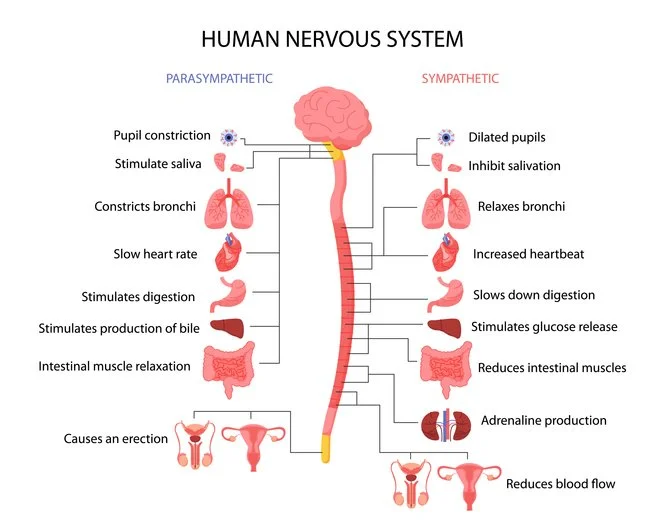
Every temperature shift sends a signal to your autonomic nervous system, the part of you that quietly runs heart rate, digestion, and stress responses. Cold is a sharp signal. Within the first minutes of cold exposure, your sympathetic "fight or flight" branch fires, norepinephrine rises, and blood pressure climbs. This is the cold-shock response, and it's well documented. Heat pulls in the other direction, toward warmth, softness, and a slower breath.
What's interesting is what happens afterward. A 2025 systematic review of cold-water immersion in healthy adults found that while stress hormones spike during and right after cold exposure, stress measures dropped significantly about twelve hours later, with improvements in sleep and quality of life as well. The same review was honest about the limits: the evidence base is still modest, and many popular claims outrun it.
So the idea behind contrast therapy is that by moving between activation and calm on purpose, in a setting where you feel safe, you give your nervous system gentle practice at shifting states and settling back down. That's a plausible and appealing idea, and the early data on stress and sleep point in a hopeful direction. It is not yet proven that contrast therapy rebuilds nervous system "resilience" or resolves trauma, so I'd hold it as a promising support rather than a treatment.
Why This Matters If You've Been Stuck
If you've been living with chronic stress, persistent pain, or ongoing inflammation, your nervous system may feel stuck in one gear. Wired and reactive. Or flat and exhausted. Or swinging between the two.
Contrast therapy may offer a gentle reminder that states are temporary, that activation can be followed by calm, and that calm doesn't have to mean collapse. Each cycle is a small, low-stakes rehearsal. Whether those rehearsals add up to lasting change is still being studied, but the experience itself is safe for most people and, for many, genuinely calming.
The Recovery Benefits: What the Research Shows
This is the part of contrast and cold therapy with the most evidence, so let me give it to you straight, including the caveats.
The most consistent finding is reduced muscle soreness. An updated 2023 review of 44 studies found cold-water immersion more effective than simply resting for easing soreness, with shorter immersions working about as well as longer ones. Reviews of contrast water therapy reach a similar place: it beats doing nothing for soreness and short-term recovery.
Now the honest caveats, because a careful reader deserves them. The contrast-therapy studies are mostly modest in quality, and contrast therapy hasn't been shown to clearly outperform simpler approaches like cold immersion alone or light active recovery. The evidence is "better than nothing," not "better than everything."
There's also a twist on inflammation worth knowing. People often assume cold lowers inflammation. The better human research doesn't support that. One careful study found cold immersion didn't reduce muscle inflammation any more than gentle movement did, and the 2025 review found cold actually nudged inflammatory markers up in the short term. That's not necessarily bad. A brief, controlled stress that the body then adapts to is how a lot of healthy training works. But it does mean the "cold therapy reduces inflammation" line is more slogan than science.
One practical note for anyone lifting weights to build muscle: regular cold-water immersion right after strength training may blunt some of the gains, according to a 2021 meta-analysis. If strength or muscle growth is your goal, timing matters, so it's worth spacing cold away from those sessions.
A Different Kind of Stress
Not all stress is harmful. Brief, controlled stressors, what researchers call hormesis, can leave the body stronger. Exercise works this way. So does the heat of a sauna and the bite of cold water.
The key word is controlled. Your body tends to benefit from stress when it's brief, when you have time to recover afterward, when you feel safe during it, and when the intensity matches where you are today. That's the spirit contrast therapy aims for: a manageable challenge followed by recovery, rather than an overwhelming shock.
The AquaLieve Experience: What Makes It Different
At our center, we use the AquaLieve Cryo/Heat Recovery System. I want to describe it honestly, including how it relates to the research above.
Unlike a traditional sauna-and-plunge setup, the AquaLieve delivers warmth and cooling through a water-based recliner while you stay clothed and comfortable. It combines thermal contrast with a dry hydrotherapy massage, gentle compression, and a zero-gravity recline position designed to take pressure off the spine and joints. For people who find a cold plunge too intense, or who struggle getting in and out of pools, that accessibility is a real advantage, and the experience is pleasant and relaxing.
Here's the honest framing. Most of the recovery and cardiovascular research was done with fairly intense methods: full cold-water immersion, hot baths that raise core temperature, and saunas. The AquaLieve is deliberately gentler and works mainly at the body's surface, so I can't promise it delivers the same measured outcomes as a cold plunge or a sauna. The proprietary features, like the massage and compression technologies, are the manufacturer's design, not findings from independent trials. What I can say is that contrast therapy in this format is comfortable, low-risk for most people, and a reasonable way to explore whether the approach helps you. Treat the deeper physiological claims as promising rather than proven.
The Experience: What a Session Feels Like
You settle into the recliner as it eases into a zero-gravity position, that weightless feeling where your body is fully supported. Warmth spreads first, and your muscles begin to soften. Then the temperature shifts cooler, and you feel the contrast. Not jarring, but waking. Throughout, gentle compression and massage work the tissues.
Many people notice muscles releasing tension they didn't know they were holding, a sense of invigoration without overwhelm, and a calm, clear-headed feeling afterward. Those subjective experiences are real and worth something, even where the deeper mechanisms are still being studied.
Who Benefits Most
Contrast therapy may support active people seeking recovery, anyone managing stress or burnout, those recovering from injury once the acute phase has passed, and people who want the experience of cold and heat in a gentler form than a plunge pool. The zero-gravity positioning also suits people with back or joint issues.
It isn't right for everyone. Please talk with your healthcare provider before trying contrast therapy if you have uncontrolled blood pressure or a cardiovascular condition, since cold can cause a sharp, temporary rise in blood pressure. The same goes for Raynaud's phenomenon, pregnancy, and any condition that reduces sensation, such as peripheral neuropathy, because blunted temperature sensing raises the risk of a burn or a cold injury you might not feel coming. When in doubt, ask first.
Working With Your Other Healing Practices
Contrast therapy doesn't replace your other care. It supports it. When you're less sore, sleeping a little better, and feeling calmer, other things tend to land more easily, from bodywork to exercise to the slower emotional work you do with a therapist or counselor. Think of it as creating better conditions for the rest of your healing.
The Wisdom of Rhythm
Your body runs on rhythms. Heartbeat, breath, sleep and waking, tension and release. Health isn't a fixed state. It's a moving balance. Trouble tends to show up when we get stuck at one extreme and lose the ability to move fluidly between them.
Contrast therapy honors that. It doesn't force your body into one ideal state. At its best, it reminds your body how to move between activation and rest, and how to find its way back to the middle.
One Last Thought
Your body has been protecting you for a long time, adapting to stress, doing its best to keep you safe. Contrast therapy is one gentle way to give it room to shift out of constant vigilance and toward restoration. Not by forcing anything, but by offering a small, safe rhythm of warmth and cold and letting your body do what it already knows how to do.
If you're curious, talk with a qualified provider, start gently, and pay attention to how you respond. That's the honest way in.
References
1. Cain T, Brinsley J, Bennett H, Nelson M, Maher C, Singh B. Effects of cold-water immersion on health and wellbeing: a systematic review and meta-analysis. PLoS One. 2025;20(1):e0317615.
2. Batista NP, de Carvalho FA, Machado AF, Micheletti JK, Pastre CM. What parameters influence the effect of cold-water immersion on muscle soreness? An updated systematic review and meta-analysis. Clinical Journal of Sport Medicine. 2023;33(1):13–25.
3. Bieuzen F, Bleakley CM, Costello JT. Contrast water therapy and exercise-induced muscle damage: a systematic review and meta-analysis. PLoS One. 2013;8(4):e62356.
4. Higgins TR, Greene DA, Baker MK. Effects of cold water immersion and contrast water therapy for recovery from team sport: a systematic review and meta-analysis. Journal of Strength and Conditioning Research. 2017;31(5):1443–1460.
5. Peake JM, Roberts LA, Figueiredo VC, et al. The effects of cold water immersion and active recovery on inflammation and cell stress responses in human skeletal muscle after resistance exercise. Journal of Physiology. 2017;595(3):695–711.
6. Malta ES, Dutra YM, Broatch JR, Bishop DJ, Zagatto AM. The effects of regular cold-water immersion use on training-induced changes in strength and endurance performance: a systematic review with meta-analysis. Sports Medicine. 2021;51(1):161–174.
7. Brunt VE, Howard MJ, Francisco MA, Ely BR, Minson CT. Passive heat therapy improves endothelial function, arterial stiffness and blood pressure in sedentary humans. Journal of Physiology. 2016;594(18):5329–5342.
8. Laukkanen JA, Laukkanen T, Kunutsor SK. Cardiovascular and other health benefits of sauna bathing: a review of the evidence. Mayo Clinic Proceedings. 2018;93(8):1111–1121.
(This article is for educational purposes only and is not medical advice. If you're considering contrast therapy, please talk with a qualified healthcare provider, especially if you have cardiovascular conditions or other health concerns).
© Proactive Health Labs