
Why We Feel Disrespected
By: Joy Stephenson-Laws, JD, Founder and President
A Charge of Disrespect at the Oscars
On March 27, 2022, Chris Rock was on stage at the Academy Awards to present the award for best documentary feature. He turned to Jada Pinkett Smith, whose head was shaved, and joked that he could not wait to see her in G.I. Jane 2. Pinkett Smith has alopecia, a condition that causes hair loss, and had spoken about publicly. Reporting at the time said it was unclear whether Rock knew.
Moments later, Will Smith walked onto the stage and slapped Rock across the face. Reuters reported that the audience laughed, thinking it was a skit. Back in his seat, Smith shouted, "Keep my wife's name out of your f***ing mouth!" Rock answered that it was a G.I. Jane joke, and Smith said it again, louder. The room went silent. The Academy later banned him from its events for ten years.
Smith's words in that exchange accused Rock of disrespect, though he did not use the word: Rock had mocked Smith's wife in front of the audience and the cameras.
What Smith Said Was Behind It
Eight months after the Oscars, Smith talked about the slap on The Daily Show. He described it as rage he had held in for a very long time. When Trevor Noah brought up his memoir, Smith said it was "a lot of things," including "the little boy that watched his father beat up his mother."
He had told that story four months before the Oscars, in his memoir Will. When he was nine, he wrote, he watched his father punch his mother in the side of the head so hard that she collapsed, and he saw her spit blood. He wrote that this moment, probably more than any other, defined who he is, and that much of what he has done since has been an apology to his mother for doing nothing that day.
The connection between the slap and what he saw at nine is Smith's own. A joke about his wife's appearance lasted a few seconds. What he says he felt reached back more than forty years.
What Research Says About Feeling Disrespected
Social psychologist Dale Miller reviewed the research on injustice and organized it around the perception of disrespect. His review describes why the same conduct can provoke different responses. People react more strongly to harm they see as intentional. They expect more respect from members of their own group, and the power relationship between two people shapes what counts as an insult. An insult delivered in front of others generally provokes more anger. Miller also cautions against assuming that a public reaction shows exactly what someone privately feels, because social rules about retaliation can make the two differ.
Management researchers Kristie Rogers and Blake Ashforth propose that respect meets two needs: to belong, and to have standing. Their paper does not examine incidents like the one at the Oscars. My reading of their framework is that a joke made at your expense, in public, can threaten both needs at once.
A third line of research studies being ignored and excluded. A 2015 analysis of 120 experiments using a simple computer ball-tossing game compared participants who were left out with participants who were included. On average, the excluded participants scored worse on measures of four needs (belonging, self-esteem, control and meaningful existence) and on other measures such as mood. The difference was largest right after the game and smaller on measures taken a few minutes later. Those experiments measured exclusion, not ridicule, and none of them measured the Oscars.
This research describes how people in general respond to disrespect and exclusion. It cannot tell us why Smith responded as he did. His own account points to his past, and that is where my experience points too.
What "You Disrespect Me" Often Means
In my experience, when someone says they feel disrespected, one of these feelings is often underneath:
Feeling invisible: "You're not listening to me. I feel like I don't matter."
Feeling undervalued: "My opinions, needs, or contributions get dismissed."
Feeling controlled: "Decisions are made without me."
Feeling re-triggered: "What you did hit an old wound that still hurts."
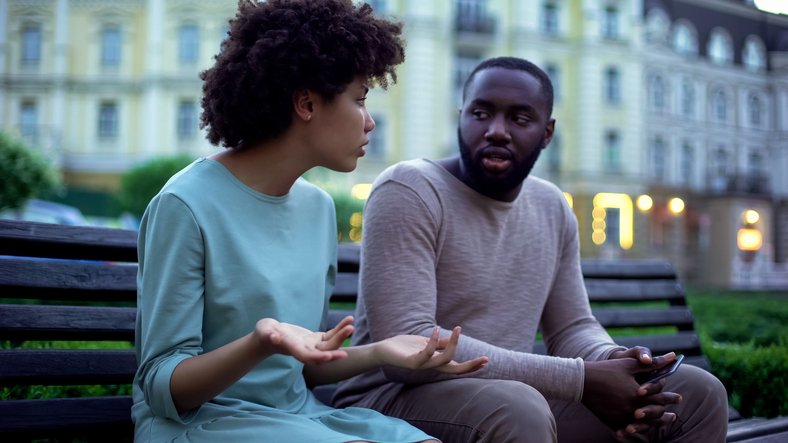
The events can be small: a partner finishes your coffee, a friend rearranges your desk, a coworker comments on your presentation. Context decides how much each one matters. A comment on a presentation can be useful feedback or public humiliation, and a rearranged desk can be a one-time annoyance or part of a pattern.
Feel. Pause. Act. When You Feel Disrespected
Feel: name the feeling, such as "I feel angry" or "I feel embarrassed." Several can arrive together.
Pause: ask yourself what happened, what you are taking it to mean, whether this has happened before with this person, and whether it reminds you of an earlier experience. Ask which of the four feelings above is underneath.
Act: choose a response that addresses the situation. You might ask what the person meant, state a boundary, end the conversation, or decide that no response is needed. You can act while you are still unsure, and you can take more time.
Final Thought
"You disrespect me" comes from a vulnerable place, and the feeling is worth listening to. It may be about the person in front of you, about an earlier experience, or both, and you may never know how much is which. The pause gives you time to look at what happened and choose what you do next.
This post is about the person who feels disrespected. Its companion, "How to Show Respect Before Anyone Has to Ask," is about the person on the other side: what you can do before anyone has to say it.
Joy Stephenson-Laws, JD, is the founding and managing partner of Stephenson, Acquisto & Colman, a healthcare litigation firm, and the founder and president of Proactive Health Labs, a national nonprofit focused on evidence-based health literacy. A healthcare attorney for more than forty years and a certified holistic wellness coach, she writes about how people can partner with their doctors without surrendering their own judgment.
Her books include Your Labs Are Fine. You're Not., Advice on Trial: The Beliefs You Inherited but Never Examined, From Chains to Wings: A Poetry Revolution for Healing,Secrets That Sparkle (and Secrets That Sting), and Minerals - The Forgotten Nutrient: Your Secret Weapon for Getting and Staying Healthy.
(This article is for general education and is not medical advice. It is meant to help you ask better questions, not to replace evaluation by a qualified clinician).
RESOURCES & FURTHER READING
Hartgerink, C. H. J., van Beest, I., Wicherts, J. M., & Williams, K. D. (2015). The ordinal effects of ostracism: A meta-analysis of 120 Cyberball studies. PLoS ONE, 10(5), e0127002. https://doi.org/10.1371/journal.pone.0127002
Miller, D. T. (2001). Disrespect and the experience of injustice. Annual Review of Psychology, 52, 527-553. https://doi.org/10.1146/annurev.psych.52.1.527
Rogers, K. M., & Ashforth, B. E. (2017). Respect in organizations: Feeling valued as "we" and "me." Journal of Management, 43(5), 1578-1608. https://doi.org/10.1177/0149206314557159
Smith, Will, with Mark Manson. Will. New York: Penguin Press, 2021.
Reuters. Report on the slap at the 94th Academy Awards, March 2022, as republished by Black Enterprise: https://blackenterprise.com/will-smith-smacks-chris-rock-on-stage-then-apologizes-upon-winning-oscar/
AFP. "Will Smith slaps Chris Rock at Oscars over wife's joke," March 2022, as republished by Daily Monitor: https://www.monitor.co.ug/uganda/lifestyle/entertainment/will-smith-slaps-chris-rock-at-oscars-over-wife-s-joke-3762490
France, Lisa Respers. "Will Smith, opening up about Oscars slap, tells Trevor Noah 'hurt people hurt people.'" CNN, November 29, 2022, as republished by ABC7: https://abc7news.com/post/will-smith-daily-show-interview-trevor-noah-oscars-slap-chris-rock/12506489/
Associated Press. "Will Smith gets 10-year Oscars ban over Chris Rock slap," April 2022, as republished by KVOA: https://www.kvoa.com/news/national/will-smith-gets-10-year-oscars-ban-over-chris-rock-slap/article_27f61ca6-b76f-11ec-8d8c-23aa7cf0ffb1.html