What Five Years of Bone Scans Taught Me About Osteopenia (and What I Wish Someone Had Told Me Sooner)
By: Joy Stephenson-Laws, JD, Founder
If you have just been told you have osteopenia, the first thing worth knowing is that osteopenia is not a disease. It is a category — and not a particularly old one.
The term was created at a 1992 World Health Organization meeting as a research convention, a way of describing bone density that sits between "normal" and "osteoporosis." Anna Tosteson, a Dartmouth professor of medicine who attended the meeting, has said publicly that the experts created the category for public health researchers and never imagined it would come to be treated as a disease in itself. The chairman of the meeting, John Kanis of the WHO Collaborating Centre for Metabolic Bone Diseases, has said the same thing. But that is what it became. Today, women in their sixties walk out of routine scans with a new label, often a prescription, and a flyer about calcium.
I am not telling you the diagnosis does not matter. It does. What I am telling you is that the number on the scan is not the endpoint. The endpoint is whether you break a bone — particularly a hip — in the years ahead. Two women with identical T-scores can have very different fracture risks depending on muscle mass, balance, fall history, family history, and a dozen other factors. The goal is not to chase a number on a scan. The goal is to stay on your feet, strong and unbroken, for as long as possible.
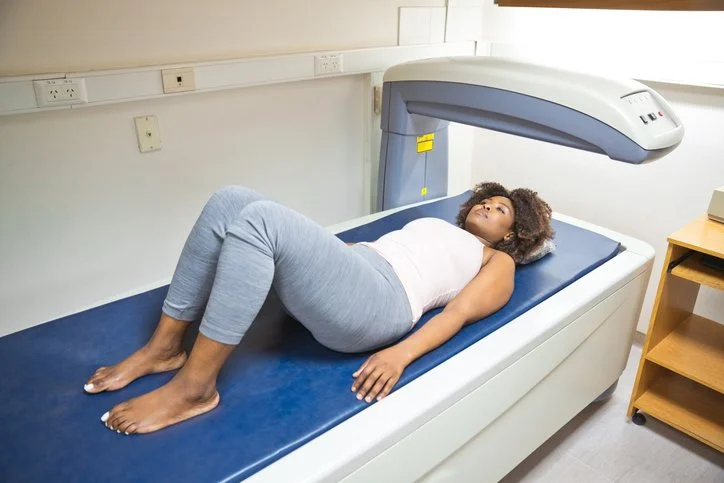
I have been getting DEXA scans for the better part of a decade. I am lean, I have been active most of my life, and I have spent the last fifteen years coaching other women on how to take care of themselves. By every conventional measure, I should have been the woman whose bones held up. My scans tell a more complicated story — my hip density has been declining faster than it should, while my spine has held relatively steady. If it can happen to a woman doing most of the right things, it is worth understanding why.
The upstream truth no one quite wants to say out loud
Here is the part most articles tiptoe around: postmenopausal bone loss is, primarily, an estrogen problem.
Estrogen restrains the cells that break down old bone. When estrogen drops sharply at menopause, those cells get busy, and bone loss accelerates — most rapidly in the first five to seven years after your last period, then slowing but never quite returning to normal. Everything else we talk about — calcium, vitamin D, exercise, supplements, even the bone drugs — is downstream management of the consequences of estrogen withdrawal.
I am not telling you to run out and start hormone therapy. I am telling you the science has shifted. The 2002 Women's Health Initiative results that scared a generation of women off HRT have been substantially re-examined, and for many women who start within ten years of menopause the risk-benefit picture looks different than we were told. This is a conversation worth re-opening with a knowledgeable provider — not closing because of something you read in 2003.
Pillar one: protein, and how much you actually need
I am going to be honest with you. I did not grow up loving protein. For most of my life, I ate too little of it, and I suspect a lot of women my age did too. We were told to watch our weight, to eat lighter as we got older, to fill up on vegetables and grains. Protein got framed as something men needed for the gym.
That advice was wrong for our bones, and it was wrong for our muscles.
Bone is roughly half protein by volume. The mineral part — the calcium and phosphate that show up on a DEXA — is deposited onto a protein scaffold, mostly collagen. Without enough dietary protein, you cannot maintain that scaffold no matter how much calcium you take. Your bones also need the pull of working muscle to stay strong, and muscles need protein to exist at all. The Framingham Osteoporosis Study followed older adults for years and found that those eating the least protein lost significantly more bone at the hip and spine than those eating more.
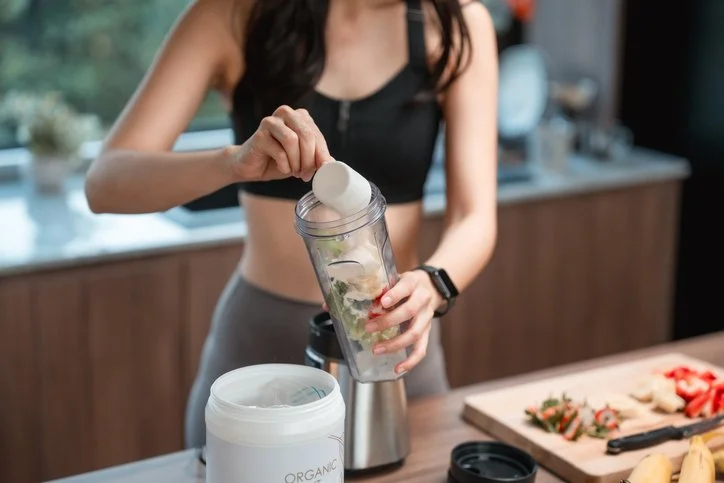
The standard recommended amount of protein — 0.8 grams per kilogram of body weight per day — was set decades ago, largely from studies in younger adults. The researchers who actually study aging bodies have been telling us for years that older adults need more. The published expert consensus now sits around 1.0 to 1.2 grams per kilogram per day for healthy older women, and higher if you are dealing with illness or recovery. For a 140-pound woman, that is roughly 75 to 95 grams of protein a day, distributed across meals — not all at dinner.
Most women I know in their sixties hit that twice a week if they are lucky.
If you do nothing else after reading this article, count your protein for a single day. Just count it. You will probably be startled.
Pillar two: lift heavy things, on purpose
This one I am still working into — and the distinction matters.
For a long time, the advice given to women with osteopenia was: walk, do weight-bearing exercise, and please careful. Walking is wonderful. It is not enough.
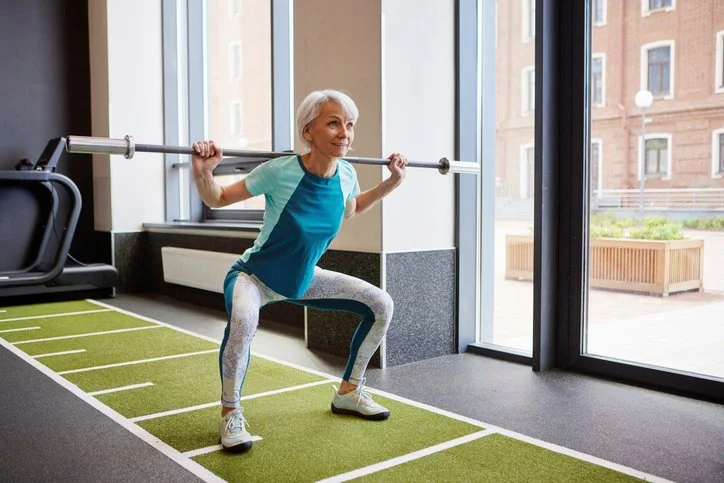
Bone responds to mechanical strain — but only above a fairly high threshold. Walking, even brisk walking, produces strain that your bones are already accustomed to, which means it does not signal new bone formation. To trigger your skeleton to actually lay down new bone, you need supra-habitual loading. In plainer terms: you need to lift things that are heavy for you, and you need to do it in a way that is genuinely challenging.
In 2018, a research team led by Belinda Beck at Griffith University in Australia published a study called LIFTMOR that changed the conversation. They took postmenopausal women with low bone density and put them through a supervised heavy resistance program — deadlifts, overhead presses, back squats — twice a week for eight months. The control group, who did low-intensity exercise, lost bone density. The heavy-lifting group gained it. There were no serious injuries.
The catch is in the word supervised. Telling a 65-year-old woman to load up a barbell at home without coaching is a recipe for trouble. Find a trainer who works with older adults, or a physical therapist who understands progressive loading. Spend the money. It is the cheapest insurance you can buy against a hip fracture.
My own body composition scans show I've held onto my muscle mass through ordinary activity and reasonable protein intake — and that's not nothing. Muscle and bone are connected; losing muscle generally accelerates losing bone. But maintaining muscle through normal activity is not the same as the heavy loading bones need to build new tissue. That's the gap I'm closing now, with proper coaching. If you haven't picked up anything heavier than a grocery bag in years, please hear me: you're not too old. The women in the LIFTMOR trial were our age and older. Your bones are still listening.
A smarter way to monitor than DEXA alone
DEXA scans are useful, but they have a serious limitation: they tell you what already happened over the previous one to two years. By the time a scan shows a meaningful change, the change is already in the past, and you have spent eighteen to twenty-four months with no idea whether your interventions were working.
There is a better tool, and most providers do not use it routinely: bone turnover markers. These are blood and urine tests that show what your bones are doing right now. CTx (a serum test) measures the rate at which bone is being broken down. P1NP measures the rate at which new bone is being formed. Together they tell you whether your bones are in net loss, net gain, or roughly balanced — and they update in months rather than years.
If you are making real changes — adding protein, starting resistance training, considering hormones — turnover markers let you see whether those changes are working long before your next scan. Ask your provider about CTx and P1NP. They are not expensive, and they close the feedback loop in a way DEXA alone cannot. My own bone turnover markers tell a story my DEXA cannot: that the loss is active, ongoing, and directly tied to estrogen withdrawal.
A few quick notes on the other things
Vitamin D matters because you cannot absorb calcium without it. Get tested, then dose to a target. Blanket supplementation in already-replete women has not shown fracture benefit; targeted correction in deficient women has.
Vitamin K2 and magnesium are the underrated supporting players. K2 activates the proteins that direct calcium into bone and help keep it out of arterial walls. Magnesium is required for the activation of vitamin D in the first place. Many American women run low on both.
Calcium from food beats calcium from a pill. The supplement evidence is weaker than the marketing suggests, and high-dose bolus calcium has raised some cardiovascular concerns. Sardines, leafy greens, dairy if you tolerate it, calcium-set tofu — these work.
The bone drugs — bisphosphonates like Fosamax, Boniva, and Prolia — are real medicine for the right patient: generally a woman with established osteoporosis or a prior fragility fracture. For osteopenia without other significant risk factors, the absolute benefit is smaller and the evidence supports trying lifestyle measures first. If your provider reaches for the prescription pad on a first scan, it is reasonable to ask: what is my actual ten-year fracture risk, and what would change if we addressed protein, resistance training, and hormones first?
What I am actually doing
I'm eating more protein than I ever have. I'm working into real resistance training — the kind heavy enough to challenge the bones, not just the muscles — slowly and with proper coaching. I'm paying attention to the upstream hormonal conversation in a way I wasn't five years ago. And I'm watching my next scan with realistic expectations: the goal is to slow the trajectory, not to chase a teenager's bone density.
You have more agency here than the diagnosis suggests. You also have less time than feels comfortable. Both are true.
If your last DEXA showed osteopenia and you walked out with a prescription and a flyer about calcium, I'd gently suggest you have not yet had the conversation that might actually matter. Go back. Bring questions. Your bones — and the rest of you — deserve a fuller answer.
Sources
On osteopenia as a research category, not a disease
Spiegel A. How a Bone Disease Grew to Fit the Prescription. NPR Morning Edition, December 21, 2009. Quotes Anna Tosteson and John Kanis on the origins of the osteopenia category at the 1992 WHO meeting.
On hormone therapy and the post-WHI consensus
The North American Menopause Society. The 2022 Hormone Therapy Position Statement of The North American Menopause Society. Menopause 2022;29(7):767–794. Confirms favorable benefit-risk profile for women under 60 or within 10 years of menopause, including bone loss prevention and fracture reduction.
On protein and bone
Hannan MT, Tucker KL, Dawson-Hughes B, Cupples LA, Felson DT, Kiel DP. Effect of Dietary Protein on Bone Loss in Elderly Men and Women: The Framingham Osteoporosis Study. J Bone Miner Res 2000;15(12):2504–2512.
Bauer J, Biolo G, Cederholm T, et al. Evidence-Based Recommendations for Optimal Dietary Protein Intake in Older People: A Position Paper from the PROT-AGE Study Group. J Am Med Dir Assoc 2013;14(8):542–559.
On heavy resistance training and bone
Watson SL, Weeks BK, Weis LJ, Harding AT, Horan SA, Beck BR. High-Intensity Resistance and Impact Training Improves Bone Mineral Density and Physical Function in Postmenopausal Women With Osteopenia and Osteoporosis: The LIFTMOR Randomized Controlled Trial. J Bone Miner Res 2018;33(2):211–220.
On bone turnover markers
International Osteoporosis Foundation. Joint consensus highlights the role of bone turnover markers in osteoporosis diagnosis and management. Reaffirms PINP and β-CTX as reference markers per IOF/IFCC/ESCEO consensus.
On vitamin D and calcium supplementation
U.S. Preventive Services Task Force. Vitamin D, Calcium, or Combined Supplementation for the Primary Prevention of Fractures in Community-Dwelling Adults: Recommendation Statement. 2018. Recommends against routine low-dose D/calcium supplementation for fracture prevention in community-dwelling postmenopausal women without deficiency or osteoporosis.
On when bone medications are recommended
Bone Health & Osteoporosis Foundation. Clinician's Guide to Prevention and Treatment of Osteoporosis. 2022 update. Establishes pharmacologic treatment criteria based on osteoporosis diagnosis, prior fracture, or osteopenia plus elevated FRAX risk thresholds.
Joy Stephenson-Laws, J.D., is a healthcare attorney with over 40 years of experience championing fairness in the healthcare system. She is the founder of Proactive Health Labs (pH Labs), a national non-profit that now embraces a holistic approach to well-being—body, mind, heart, and spirit. As a certified holistic wellness coach, she helps individuals and families create practical, lasting health strategies. Her own experiences as a mother inspired her to write resources that spark important conversations about safety and wellness.
She is the author of Minerals – The Forgotten Nutrient: Your Secret Weapon for Getting and Staying Healthy.Her children’s book, Secrets That Sparkle (and Secrets That Sting), empowers kids to recognize safe vs. unsafe secrets in a gentle, age-appropriate way.
Her latest book, From Chains to Wings, offers compassionate tools for resilience, healing, and emotional freedom.